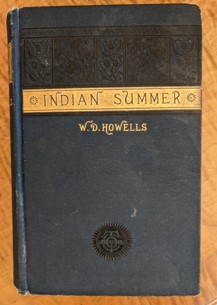
Indian Summer
W. D. Howells
Ticknor and Company, 1886
Indian Summer
W. D. Howells
Ticknor and Company, 1886
Description
(From back of NYRB Classics 2004 edition) One of the most charming and memorable romantic comedies in American literature, William Dean Howells’s Indian Summer tells of a season in the life of Theodore Colville. Colville, just turned forty, has spent years as a successful midwestern newspaper publisher. Now he sells his business and heads for Italy, where as a young man he had dreamed of a career as an architect and fallen hopelessly in love. In Florence, Colville runs into Lina Bowen, sometime best friend of the woman who jilted him and the vivacious survivor of an unhappy marriage. He also meets her young visitor, twenty-year-old Imogene Graham—lovely, earnest to a fault, and brimming with the excitement of her first encounter with the great world.
The drama that plays out among these three gifted and well-meaning people against the backdrop of Florence, the brilliance of their repartee, and the accumulating burden of their mutual misunderstandings make for a comedy of errors that is as winning as it is wise.
Notes
Indian Summer is less comedic than it is painful and less about a man's midlife crisis than it is about the social constraints that would leave three intelligent, wholly sympathetic female characters "dragged through the dust" as one puts it, while he figures himself out. It's not quite clear why they all consider him the finest man they've ever known -- we're privy to all his inner thoughts, and they're pretty banal, but he's not a bad guy, and the book does have a lot of charm. Unlike novels from the 20th century, which are more concerned with moving the plot along, it proceeds at a leisurely pace, with whole chapters of conversation about the history and sights of Florence and various, somewhat random, musings on religion, on aging, on gender relations, and on the differences between European and American self-conceptions/worldviews.
There's an underlying feminist thread, never fully developed, that may be the most interesting part of it: the female characters are smart and capable, and it's portrayed as negative that the younger woman's best school friend is being prevented by her family from entering the clergy or even medicine. An older clergyman argues that marriages between older women and younger men are healthier than the reverse because women age better than men -- and, indeed, the female character who is 38 is described as being every bit as beautiful as her younger charge, and certainly in much better shape than the hero, at 41 (much of the humor in the book comes from his age-related ailments -- rheumatism in his shoulder, a St. Nicholas-approaching physique, the need for an afternoon nap,etc.).
There's also intriguing discussion on the contrast between American girlhood in the 1840's and '50's -- with its "girlish liberty as wide as the continent, as fast as the Mississippi" and the present conservativism of the 80's. The older female character, in arguing that she wouldn't raise her daughter that way, says that times are different now. How?
Flags: If you are approaching or exceeding 40, the middle-aged stuff can sting. :)
Tags
1800s, other, 1880s, American, Europe, Italy, Victorian, accident, vehicular, other, age difference, beautiful/handsome, business owner, calm/tranquil, curvy/stocky, disappointed in love, disciplined, f/m, intelligent, journalist, late to love, male, middle-aged, midlife crisis, never love again, parent, principled, reserved, rich, romance, second chance, single, third-person, widowed
Flags
None