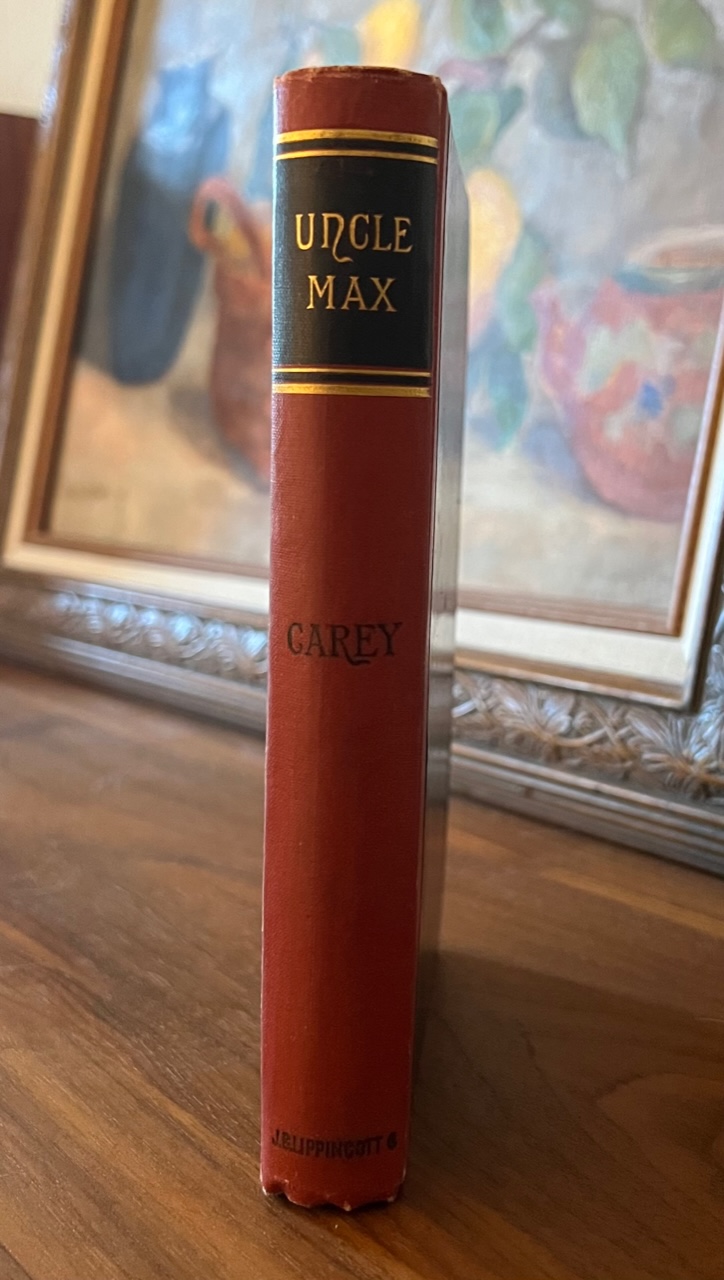
Uncle Max
Rosa Nouchette Carey
J. B. Lippincott Company, 1887
Uncle Max
Rosa Nouchette Carey
J. B. Lippincott Company, 1887
Description
Bereft after her twin brother's death, 25-year-old Ursula Garston studies nursing and takes her skills and her three hundred pounds a year to her young Uncle Max's parish, where she hopes to find meaning and purpose ministering to the poor. At Heathfield, Ursula finds herself quickly drawn into the lives and hearts of the wealthy Hamilton family -- and into their dangerous secrets.
Notes
There's a lot to like in Uncle Max and a lot of text to like it in: 381 close-set, small-typed pages in my edition. Plain, principled, independent-minded Ursula, moves to the countryside and meets the wealthy, eccentric Giles Hamilton, Esq. who doctors only the poor and always gratis. They initially dislike each other: she finds him domineering and sexist; as a womanhater (or, at least, skeptic) he mistrusts her motives and casts her as a dreamer who won't stick and who's taken up nursing out of a desire for attention and, likely, from disappointment in love. This goes where you would expect it to, but with so much more, and more interesting, plot and themes along the way. It's really a study in suffering and loss. Almost everyone in "Uncle Max" has experienced the trauma of losing someone close to them -- someone young in most cases -- humans in Carey's world are "born to trouble as the sparks fly upward" (286) -- and the mental and physical toll of grief is treated seriously and with care. Ursula's answer, "muscular Christianity", is clearly Carey's view: healing comes to her characters through service, sacrifice, and doing the work of building new emotionally intimate and supportive relationships. Much of this intimacy is in close bonds between women: Ursula's deep friendship with Gladys Hamilton and her care for her younger cousin receive as much attention as her romance does and there is also a touching subplot about a relationship between sisters.
The substantive focus of the book is, unsurprisingly, on gender and gender roles: Carey promotes respect for "women's work" -- emotional and practical -- in her descriptions of its complexity, the intellectual and physical energy involved, and the consequences to health & wellbeing of it being done poorly or well. She also, though, shows the cost of the separate spheres: the gothic side of the plot involves a domestic power struggle between women, all the more chilling for its intimacy, and it's men's absenting themselves from the "female" sphere that causes the novels highest drama (and, very nearly, disaster). As Ursula puts it: "Oh, the stupidity and slowness of these honorable men where a woman is concerned!"
In the end, it is a happy, if partial, fracturing of the spheres that brings Ursula to contentment: she finds a partner who wants her to go on with her work, who respects her intellect, appreciates when she contradicts him, apologizes when he's wrong, but who still "means to spoil [her] dreadfully".
I haven't read much Victorian-era popular fiction, but Uncle Max is inspiring me to dive deeper. I've just ordered a copy of Elaine Hartnell's Religion, Gender, and Domesticity in the Novels of Rosa Nouchette Carey.
Tags
1880s, English, Europe, England, Victorian, arrogant, big, brave, courageous, calm/tranquil, clever, determined, disappointed in love, disciplined, doctor, dominant, f/m, female, first-person, gothic, gullible, idealistic, independent, intelligent, kind, lovers, enemies to, loyal, moving to the country, mystery, never love again, nurse, one woman has hurt you, plain, practical, principled, prosperous, recommended, religious, religious, Christian, reserved, rich, robust, romance, selfless, single, smart guy fooled by conniver, strong, strong f/f friendship, tall, temperamental, ugly, womanhater/manhater, young
Flags
None