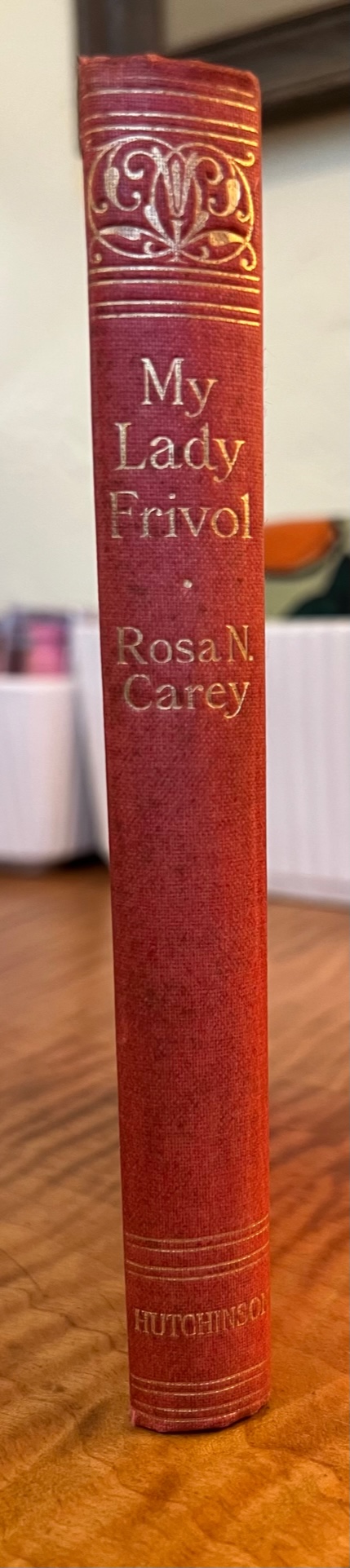
My Lady Frivol
Rosa Nouchette Carey
Hutchinson & Co., 1899
My Lady Frivol
Rosa Nouchette Carey
Hutchinson & Co., 1899
Description
[from review in The Guardian, Tue., Oct 3, 1899]
"My Lady Frivol" is an undisciplined young woman of fifteen, not the untutored savage, but a girl of gentle birth who has been allowed to run wild. She is the centre of things, round whom various groups of anxious elders revolve. Her uncle-guardian Alick Redford, her actress-mother, and her governess Eden Lloyd are nearest; then come the few families in the neighbourhood, with a vicar's wife, who forms a kind of Greek chorus; and an outermost ring of Eden Lloyd's relations, who are there to explain her taking the situation of governess to "Lady Frivol." The seemingly indifferent squire -- with a past -- who marries his ward's governess has been with us in weaker and weaker dilutions since "Jane Eyre" was written. Happily Miss Carey's dilution is not of the weakest, for Eden Lloyd is a san, healthy person, and the squire is quite human. The story runs on in accepted fashion to a pleasant ending, and contains some pretty scenes...
Notes
About My Lady Frivol and its author, The Evening Standard writes: "She appeals to that enormous class -- composed chiefly, perhaps altogether of her own sex -- that likes a simple, absolutely moral, fairly well-written, unambitious, middle-class love story -- a story in which love and twaddle (we do not say it unkindly) predominate." (Th Feb 15 1900) This assessment may be, in large measure true, but at the same time: count me in. There's a place for decently written comfort-reads and the moralizing in Carey's work is done with a light touch. The wholesomeness goes down easy -- nothing overly didactic -- and the sentiment doesn't cloy.
Lady Frivol isn't nearly as good as Uncle Max, but it's still a pleasant, occasionally thought-provoking, read. Eden is a smart, educated, practical, and independent young woman whose firmness in advocating for herself is "often misintepreted as obstinancy". She takes on a paid career as a governess, not because she has no choice, but because she prefers it to dependency. Not a bad model for turn of the century girls and an enjoyable companion for a few hours' read. The squire, Alick Redford, he of the "close-cropped" hair that "shown like grey velvet in the sunshine" (41) follows the popular man-blighted-in-love mold -- gruff, avoiding the society of women, and, indeed, of most of his neighbors. It seems funny to us that it was considered, at least in popular literature, natural, and no reflection on the essential character of a man to have disappointment in love turn him into a misanthropic recluse. "She had long discerned that his nature was a noble one. Although adverse circumstances had warped it, these rough excrescences and humours were only like the rugged bark of some sturdy tree -- within, the timer was smooth and finely seasoned", etc., etc. I'd love to trace the rise and fall of this trope -- it was certainly on the wane by the time Ilsa administered her get-it-together "one woman has hurt you" speech to Rick Blaine...
One thing I love about Carey is that she's very observant of even side characters, giving them full, rich particular lives. Eden's clergy/scholar brother's marriage and family, for instance, come under her even-handed scrutiny: Rosamond and Hillis "suited each other perfectly", but in their high ideals and focus on the life of the mind and on moral duty, they are also neglecting care of themselves and their daughters -- the disabled one, who's starved of attention and emotional support, and the abled one who's overworked in her parish and familial responsiblities. It's an interesting "tend your garden" insight.
There's a lot of death in My Lady Frivol, as in Carey's other books, and a particularly heartbreaking theme of child illness and death and what that meant to families. In fact, one strand running through her work is how to behave with dignity and grace, and how to build a life of meaning, in the face of loss. Here, that's embodied in the vicar and his wife, who are mourning their little girl, in the aging, blind Lady Margaret who is, in a nice touch, Alick Redford's best friend, and in teenage Bonnie, who finds her first experience "brought face to face with the veiled mysteries of death and sorrow", a maturing, growth experience.
Even the villains in Lady Frivol aren't truly "bad" -- they're just weak & selfish & their own worst enemies, and Bonnie's actress-mother gets something of a redemption arc before dying (as I said, lots of death), though not before sending a letter with the wonderful sign-off I intend to borrow freely:
"I remain
Your much maligned and resentful,
Madelon Redford"
Turn to Carey for reading that's far from taxing, but not, actually, as frivolous as all that...
Flags: One use of the n-word in the phrase "work as hard as..." A character sings stereotypical minstrel songs. References to child death.
Tags
1890s, English, Europe, England, Victorian, calm/tranquil, cheerful, clever, competent, determined, difficult child, eccentric/quirky/neurodivergent, employer/employee, f/m, female, governess/paid companion, guardian, hair, gray, inherited a child/instakid, jilted/left at the altar, landowner, middle-aged, never love again, not the type to fall in love, one woman has hurt you, orphaned, practical, principled, reappearance of old love, recluse, rich, romance, single, strong, strong m/f friendship, third-person, womanhater/manhater, young
Flags
child death/miscarriage