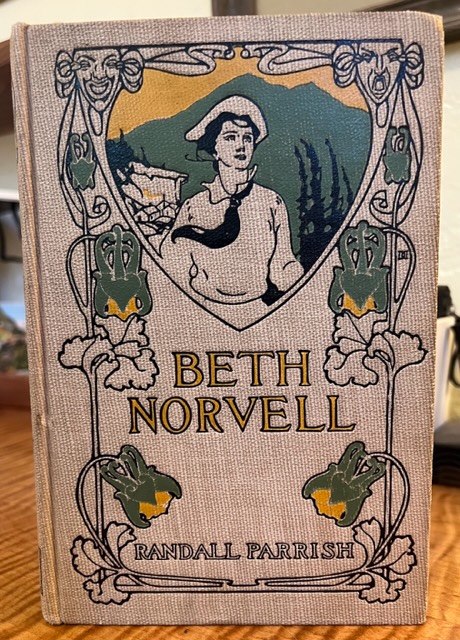
Beth Norvell
Randall Parrish
A. C. MuClurg & Co., 1907
Beth Norvell
Randall Parrish
A. C. MuClurg & Co., 1907
Description
[from review in The San Francisco Call, Oct 13, 1907] This tale of Beth Norvell is a romance of the west. The story tells of a young mining engineer who becomes infatuated with the leading lady of a traveling theatrical troupe of second or third quality. He has a few idle months on hand and allows his infatuation to carry him so far that he joins the troupe in a menial capacity in order to be near her. Soon the young man is desperately in love, but the lady scarcely notices him. The manager and the leading man of the company decamp with the funds, leaving the company stranded in a small frontier town, and Beth is thrown upon her own resources. A most villainous villain has a secret over "Beth" and he uses his knowledge to get what he desires from the young engineer. There are several good fights and some good descriptions of mountain scenery and mining districts...
Notes
How's your tolerance for dialect? It better be high for this one because Parrish dishes out, at length and with obvious relish: German, Mexican, Irish, Swedish, and old miner. And another character stutters. This would work better if his skill matched his gusto: as the same SF Call piece above puts it, with enviable restraint: "A good character study is developed in Mercedes, the bad Mexican dancer, but Mr. Parrish has a lot yet to learn in Mexican-American dialect." Saprisi! (which Mercedes for some reason is forever exclaiming, not in Spanish).
Beth Norvell, as you might be cottoning on to, is a kind of frustrating book. Contemporary reviews call it just right: the mining parts are vivid and entertaining, the love story is pretty much a frigid snooze. Parrish had gone West, as a young man, himself: he worked the railroads and drove sheep in Nevada and NM, even meeting Billy the Kidd (alive and dead). His descriptions of mining camps and an unsettled West where "It's generally lead first, an' lawyers later" ring true and the dialogue and interaction between the miners and the young engineer are lively, as is the action when the latter starts investigating highgrading by some nefarious, well-funded, rivals.
The romance, itself, though, retreats into the stiffly Victorian, all overly formal language and overly stuffy morality. It's kind of a shame because Parrish's heart is in the right place. Along with being a dime store novelist, he was a Congregational minister, and it's clear he had views on what strict socio-religious expectations cost young women. Early on, Beth makes a stirring defense of a woman's right to make difficult life decisions without reference to "social respectability" or a man's good opinion, and she decries that, whenever a question of morality arose, "it was always the woman who bore the burden of condemnation." (135) Parrish almost explicitly uses Beth's (and Mercedes') experiences as an illustration of the (mis)use of God and religion as tools in the patriarchal control of women and the emotionally strongest passages in the book are ones that argue against judging women for making hard choices in a hard world, and for a more sympathetic understanding of people's circumstances (for instance, that domestic abuse is real and "divorce is not always the evil that some delight to proclaim it"). He even has Beth insist, at one point -- and the male MC agree -- that love should not seek to turn a woman from her career/avocation: "I cannot conceive of any love so supremely selfish as to retard the development of a worthy ideal." So, it's a shame that the language is so stilted and, that her character is almost masochistically burdened by religious convention. And then Mercedes, the book's most sympathetic character (once you excavate her from the dialect) gets the rawest deal. This may be the author's point, but it's never fun to watch characters sacrificed to make it, especially in what's, otherwise, the lightest of entertainment. So: frustrating.
As you'd expect from the time, there's quite a bit of gender and ethnic essentialism -- "fiery blood of the south" (152), etc. -- and some insensitive language surrounding ethnicity and religion. Mild references to domestic violence. A character, as noted above, stutters, but this is treated affectionately: "he sputter like the champagne when it uncorked".
Tags
1900-1909, American, United States, Southwest, actor, adventure, already taken, artistic, athletic, beautiful/handsome, brave, courageous, engineer, escape old life, f/m, forbidden love, hair, dark, idealistic, identity, concealed, independent, intelligent, love at first sight, male, married, named Elizabeth, on the road, principled, protector, religious, Christian, rich, riches to rags, romance, secret past/my lips are sealed, single, strong, third-person, western, young
Flags
domestic violence