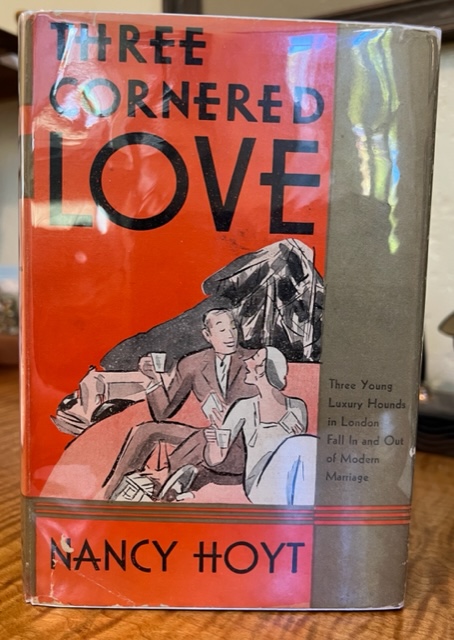
Three Cornered Love
Nancy Hoyt
Caxton House, 1939
Three Cornered Love
Nancy Hoyt
Caxton House, 1939
Description
[from inside flap Caxton House dj] Their father settled the three young Dovers in a charming small house in Filbert Grove, London S. W. 7, gave them each a small income and hoped for the best. They all loved London. Andy, thirty and divorced, because he liked its smell and form. Ann, twenty-seven, ditto, adored it because she had beaus and business and loved house-keeping in South Kensington. Tony, the youngest, liked to dance and play squash at the Bath Club. And England loved them in their own casual trans-Atlantic fashion. This is the witty, gay, and sometimes very wise chronicle of their London adventures in love.
Notes
It's really hard to know how to write about this one. Three Cornered Love is billed as a romance, but it's really not that in any traditional, genre sense. The emotional center of the book is really the relationships between the three siblings, and the oldest brother and sister -- Ann and Andy -- especially ("His sister, whom he liked better than any other human being, came in and fell upon the rumpled bed he had so recently vacated", etc. (69)). The characters feel very '30s -- the children of wealth, drink and cigarettes ever at hand, at once cynical and unworldly, not quite as ineffectual as they let on or believe themselves to be. Hoyt is honest about them, as they are mainly with themselves, so the reader's sympathy has the same sort of semi-reluctant, exasperated quality as their harried dad's. They're misfits and they make messes of their lives, but their affection for each other is real, warm, and at moments, surprisingly touching. As when Tony, about to dive into matrimony, overhears the older two's whispering confidences: "The tuth is, we are trouble wagons...It's the quality of leaping a good two years before you look which lands us and our young friends in these jams. Now couldn't we possibly draw off the trouble from young Anthony? Couldn't we attract it to ourselves? You and I are so used to trouble that we'd hardly know what it was all about it if life ran too smoothly for us. I'm beginning to think we like it. But oh, Andy, Andy, don't let's let Tony go through it..." (233)
Nancy Hoyt came from a prominent, wealthy Philadelphia family, one of five siblings that seemed born to brilliance (her older sister was the poet Elinor Wylie), scandal, and tragedy (2 suicides, 2 deaths from substance abuse, Elinor's early, fatal stroke). There's an excellent blog post on Nancy and the family here. Reading Three Corner Love, you feel in your bones that some of the siblings' care for each other, and confusion about life, are drawn from Nancy's reality. Only here, the flawed, lovable young Dovers get their happyish, or, at least, hopeful, endings...
Interesting reflections on the contrast between the '10s and the '30s, and, if you're interested in how vintage light fiction treats weight, a fat character who's portrayed as attractive and desirable, even if his nickname is Tubby.
Flags: one use of n-word. If you are sensitive to trauma involving teeth, there's some of that (three front teeth knocked out and replaced in an episode that certainly defies all I know of dental best practices).
Tags
1930s, American, Europe, England, United States, Northeast, f/m, female, heir/heiress, lovers, spoiled for choice, one wonderful day/week/month/year, romance, strong m/f friendship, taught a lesson, third-person
Flags
insensitive or outdated language (race/ethnicity/disability/sexual orientation)