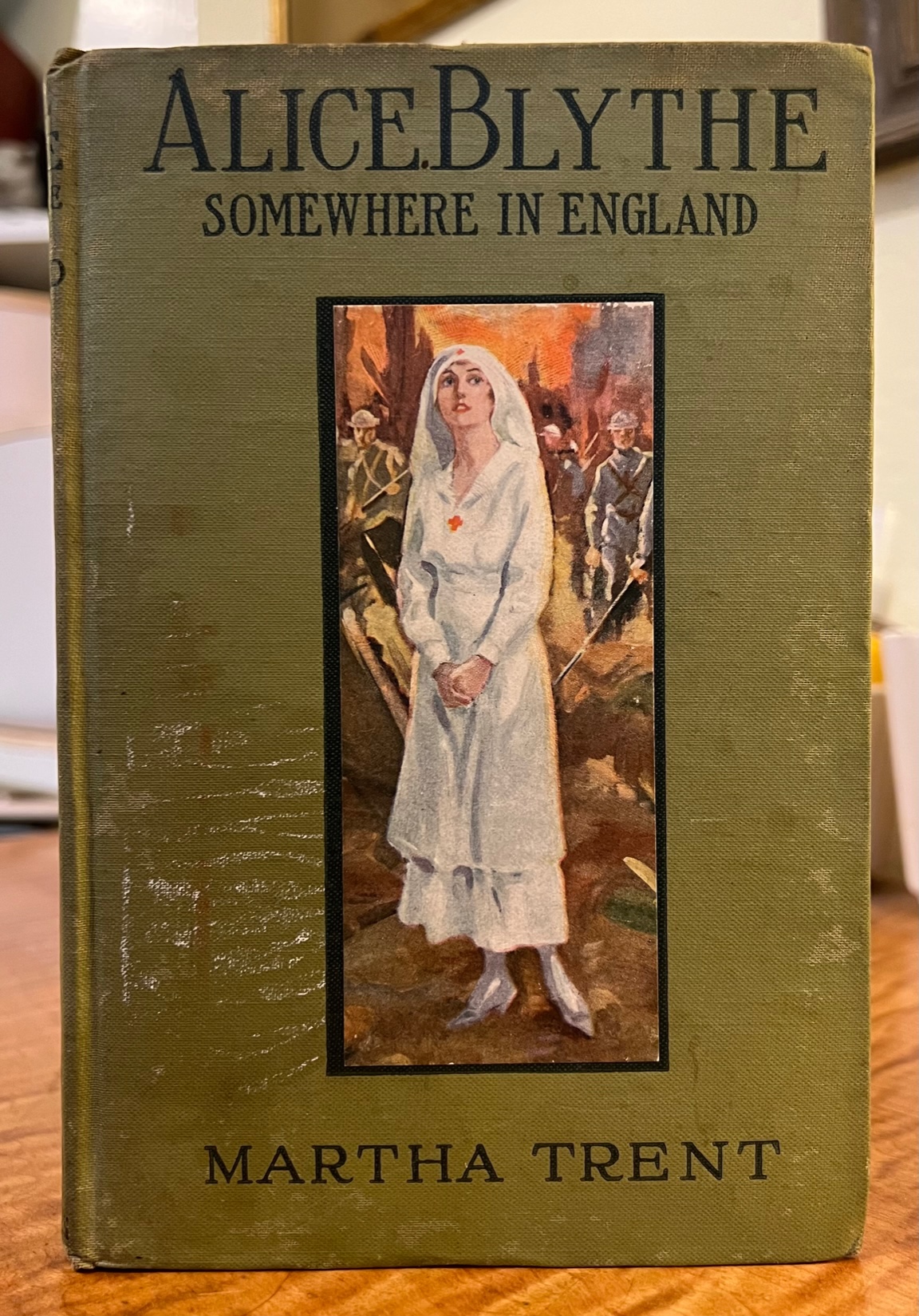
Alice Blythe: Somewhere in England
Martha Trent
None, 1918
Alice Blythe: Somewhere in England
Martha Trent
None, 1918
Description
[From "The Somewhere Series" advertisement, back of book]
Around a central figure, "half girl, half boy, and the better half of each," the author has written a fascinating story laying the plot first in America and subsequently, in the other stories, in other countries. The author's intimate knowledge and deep insight into the life and surroundings of the young heroines in the various countries add distinct educational value to the pronounced charm and quaintness of the stories.
A peculiarly timely series of books for young readers who have been following the progress of the war.
Nice summary of the Alice Blythe installation by Rich Horton here.
Notes
Alice Blythe, nickname "Cricket", "a tall very fair girl with a set of broad sloping shoulders that a boy might have envied, and a slim waist" (12) begins the book struggling to find her way to make a contribution to the war effort. Her parents, doing medical war jobs in London, have sent her to stay with old aunts in the country: at 16, she's too young ("She really means I'm too clumsy") for hospital work. She struggles mightily with her volunteer knitting, bemoans the fact that she "can't be nice and dainty and ladylike" (19), tears around the countryside in her brother's car, and takes secret flying lessons from a distant cousin who's in training for the RAF. This cousin and she are "comrades of long standing...Peter never felt that he must protect Alice from danger, and Alice never felt that he ought to. If there was a danger ahead they met it together side by side, and shared equally in the result." (29) When Peter gets his commission and heads to France, they stiffen their upper lips and part:
"...write when you get a chance, and of course, win all the decorations."
"Oh, naturally" Peter replied "I've always intended to do that."
They shook hands and looked at each other squarely as comrades should. (52)
With Peter abroad and in danger, Alice is done with sitting around ripping back her bad knitting: "I want to do something that takes lots of strength and all my time." (75) She convinces a doctor friend of her brother's to get her a maintenance job at his Base Hospital in an old French chateau. Once there, she meets Helen Carey (from Book 1) and Marieken De Bruin (from Book 2), works hard and gets dirty, and do you think, by any chance, her driving and flying skills will end up paying off? And her feelings for the sturdy young pilot turn more than comradely?
Like Marieken, this is squarely a children's book that I would have really enjoyed at, say, 8 or 9. In that age range, it would provide a nice context for discussions about propaganda and about girls' changing roles and opportunities. What was the author trying to say about girls' capabilities and the limits of their participation? What message is she trying to convey about what she feels the British national character is like, how young people should behave in the face of danger and loss, and what they owe their country? There's some accessible academic work to guide this conversation: for example, Emily Hamilton's Girls to the Rescue: Young Heroines in American Series Fiction of World War I partially viewable on Google Books.
Tags
1910-1919, English, Europe, England, Europe, France, accident, vehicular, plane crash, adventure, athletic, beautiful/handsome, big, brave, courageous, cheerful, competent, f/m, female, hair, blond(e), hospital, independent, intelligent, lovers, friends to, orphaned, pilot/aviator, practical, principled, romance, single, soldier, spirited, strong, third-person, war, we thought you were dead!, young
Flags
None