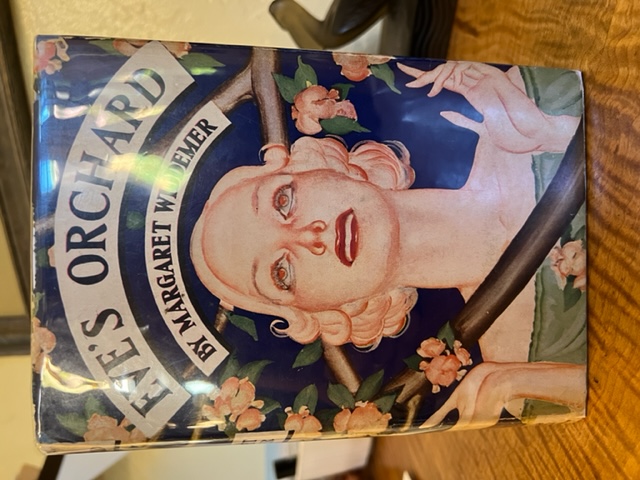
Eve's Orchard
Margaret Widdemer
Farrar & Rinehart, Inc., 1935
Eve's Orchard
Margaret Widdemer
Farrar & Rinehart, Inc., 1935
Description
The romance of a house, actually, and of Eve Mannersfield who owned it -- a quiet, lovely house in Connecticut, a house with an orchard. Miss Widdemer writes quietly and with graceful humor of a girl who, returning to her native New England from a life of business success and gayety in New York City, finds that life has new problems, new responsibilities and abiding loyalties. She discovers that it is not only a new manner of living that is important to her; but also the man who, in the atmosphere of town life seemed glamorous, becomes a new influence as she turns to older values. Her near-tragedy is averted. Her life and the lives of those about her fall into a clearer pattern.
A nostalgic book -- and one in which Miss Widdemer creates her most appealing heroine.
Notes
Eve, orphaned young and raised by an aunt who runs a baking business out of their ancestral Connecticut home, throws up her job as a promising NYC publicity assistant after becoming (secretly) engaged to a charming, mercurial, pleasure-loving young Southerner. When a career disappointment on his end postpones their marriage, she retreats to the childhood home she's inherited where she acquires, in short order, an old man, a small boy, a pair of sponging houseguests, a cow, and an interesting neighbor -- son of the Chairman of Northern Steel, a Harvard grad of 10 years, and already a renowned pomologist. Will she stick with the feckless fiance or shift her favors to blue-eyed, wind-burnt, quiet & dependable boy next door? What do you think? It's an old story, Eve and her apples, but here there's no serpent but a snake-in-the-grass wealthy widow friend, and it's not Eve who's tempted there.
This is one of Widdemer's better books, in my opinion -- more about Eve's rediscovering her principles and finding strength in being true to them than it is about the romance, even, and I always enjoy a good building-a-business theme, too. Widdemer is really good at drawing deeply unlikable side character -- narcissistic, manipulative, abusive, or just plain unhinged -- and, while I'm not sure anything tops Loyal Lover in that department, the ones here are satisfyingly unpleasant. Interesting references, as usual, to the differences between pre- and post-war (that's WWI) values, which seems to have been a preoccupation of Widdemer's during this period at least. Downsides: the n-word is used once and there's a kind of uncomfortable suggestion of the heritability of "good" traits -- "pride of race", etc. (though she means, specifically, Connecticut old-stock Quality). Also on display, her penchant for overdescribing food ("They got quite friendly over the hot creamy coffee, the buttery rolls..", etc.), which is one of my pet peeves -- a Pulitzer-Prize-winning poet really should know better, right?
Tags
1930s, American, United States, Northeast, already taken, beautiful/handsome, big, business owner, calm/tranquil, career, unusual, cheerful, competent, determined, disciplined, f/m, family home, female, forthright, friend, selfless, generous, hair, blond(e), inherited a child/instakid, intelligent, landowner, love someone else, lovers, friends to, lovers, neighbors to, loyal, moving to the country, orphaned, pomologist, practical, principled, quiet, rich, romance, saving the family home, scientist, selfless, single, spirited, strong, strong f/f friendship, tall, third-person, young
Flags
child abuse, insensitive or outdated language (race/ethnicity/disability/sexual orientation)