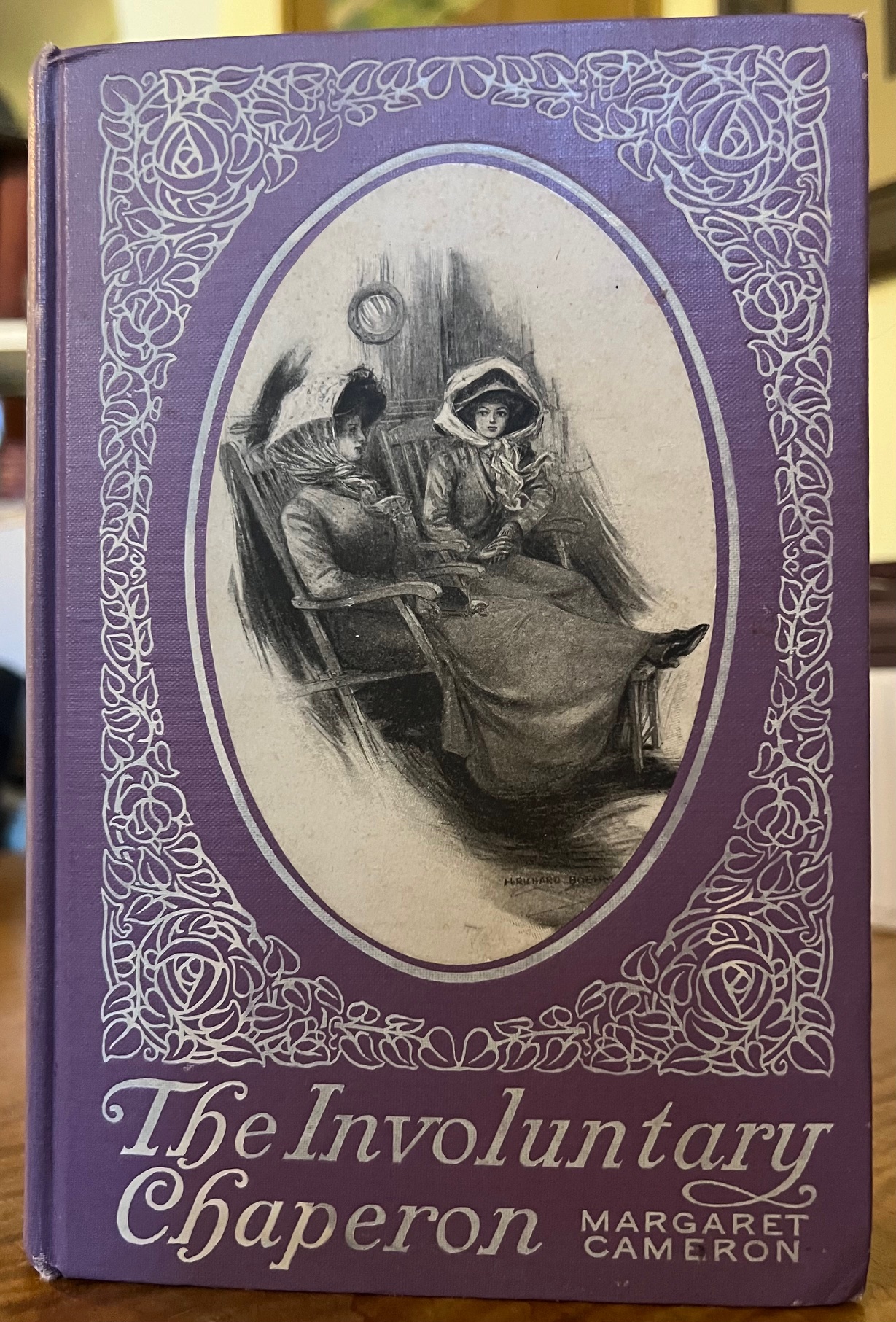
The Involuntary Chaperon
Margaret Cameron
Harper & Brothers, 1909
The Involuntary Chaperon
Margaret Cameron
Harper & Brothers, 1909
Description
[from review in The Boston Globe, Sat. Oct 30, 1909].
Romance and Travel Combined.
Margaret Cameron's new novel, "The Involuntary Chaperon," is refreshingly unconventional in theme and treatment, and happily accomplishes the difficult task of combining stirring romance with graphic description of foreign travel. The story is told in the form of letters written to a woman friend by a young widow who makes a trip to South America to chaperon a 17-year-old girl sent away out of reach of an "ineligible" suitor. The girl's bachelor uncle accompanies them, and very soon the chaperon has a love affair of her own to attend to, more than one in fact, for the bachelor uncle is not alone in his appreciation of the charming widow. The young girl also becomes entangled in several unlooked for romances, and the resulting complications, skilfully developed and delightfully entertaining, hold the eager interest of the reader. It is not only a capital story but also a work of literary distinction, and it well worth reading.
Notes
Margaret Cameron (1867-1947), not to be confused with the photographer Julia Margaret Cameron (1815-1879), was a Santa Barbara-raised musician and author. Her personal history, per her rather odd Wikipedia profile is an interesting one: she and her family had moved to California for her father’s health, after the Scotland-born lawyer became ill during his American Civil War service. Upon his death, she and her mother struggled financially until the latter opened a successful dressmaking business, which she eventually relocated to the more urbane San Francisco. Margaret experimented in various arts, eventually becoming a highly-regarded piano teacher and accompanist. In 1898, she met author William C. Morris and joined a class he’d started, in Oakland, on “The Art of Writing for Publication”. It turned out she had knack for humorous writing and soon was penning one-act plays for local theater and short stories for Harper’s Magazine. In 1903, she married Harrison Cass Lewis, who had been her childhood playmate in Illinois (they reconnected at the 1893 World’s Columbian Exposition in Chicago). He was General Manager and Vice-President of the National Paper & Type Company, which exported printer’s materials to Latin America. Her travels with him gave her the material for two novels The Involuntary Chaperon (South America) and The Pretender Person (Mexico). Interestingly, the book she’s best known for is a Spiritualist work from 1918 — The Seven Purposes — in which she purported to convey lessons on living from souls in the beyond. This book was controversial — Willard K. Bassett in his “Books and Writers of Them” column in the Honolulu Advertiser (Sun Sept 28, 1919) wasn’t buying the planchette and pencil deal and declared tartly that she should have given her philosophy on “’right human relations’…to the world in less dramatic form” — but also hugely popular: Sir Arthur Conan Doyle declared it “thrilled him through and through” (Dayton Daily News, Sun Jun 29, 1919) and it is considered the first American-published “study of pyschic phenomena” to achieve widespread readership. I haven’t gotten a chance to really dip into The Seven Purposes, but, honestly, I’m kind of with Bassett: in the few excerpts I’ve read the spirits converse in a voice that, once you've spent time with The Involuntary Chaperon’s narrator sounds...pretty familiar. The desire for this kind of communication is completely understandable to me — the seekers, at that time, heartbreakingly, legions of war-bereaved mothers — but the authoring of it, less so. Margaret seems to have been a good, and sane, person, so I like to think of hers as an attempt at kindness and comfort rather than delusion or exploitation. It’s tricky.
For its part, The Involuntary Chaperon was also a first: per her obituary in The Boston Globe (Wed Feb 5, 1947), Chaperon “was recognized as the first South American travel book published in this country and for years served as a guide to that continent” — “a sort of literary Baedeker” (Oakland Tribune Sat Jul 19, 1913). Margaret herself declared of Involuntary that “every incident not connected with the love story is fact and every character fiction.” (The Sun, New York, Wed. Oct 13, 1909) but that fact that the two main male leads share, the one, details of her husband’s biography, and, the other, his profession, suggest some truth crept into the romance, too.
Altogether, I loved this book. The narrator, “unattached and impecunious widow” (2) Anne Black Pomeroy is a Californian — unusual for a writer of that period (the total population of CA in 1900 was just under 1.5 million) — so the landscapes of her heart are also mine. When she describes what she sees in South America in terms of their California equivalents — “The Santa Clara Valley, this time, minus the live-oaks and plus the cordillera” (187) — and the voyage south as moving through “a looking glass world” of the North American West Coast, I understand what she’s saying on a kind of visceral level, which is a nice change from all the Britain and NY-set stories which I enjoy so much, but don’t really “get” in the same way. Anne/Margaret is an enthusiastic and open-hearted traveler and I love how much she loves the lands she visits — “Marion, I am drunk! Drunk as any lord - on color! This is all the dreams I ever dreamed come true.” (290) — and how much respect (with some unfortunate qualifications — see Flags) she has for the South American people she gets to know, both native and transplant: their hospitality, their pride in their homelands, their sense of optimism for the future of countries still in their “splendid youth”. (289) You feel her own pride and optimism — almost giddiness when she takes the train to Culebra to see “the big cut”: the Panama Canal in progress — as an American at the dawn of what would be the American century and it’s infectious. That said, she’s clear-sighted, too: there’s already the incurious and entitled fellow tourist “He is what is technically known as an ‘Amurican’” (59) And she is so frequently irritated by American’s lack of quality control in packing for export that it made the San Francisco Chronicle review as “very impressive picture” of “the neglect of trade opportunities on the part of this country with her neighbors.” (Sun Nov 7 1909) Overall though, her narration is filled with color, care, and joy — you can tell what travel meant to her and how much she — meaning Margaret — was learning from it. It’s like a little window into how a smart, invested young woman experienced the 20th century’s opening world and her country’s changing place in it.
Along with being a delightful travel writer, Anne is also a delightful personal voice. She’s sensible, humorous — her descriptions of the “bored, lifeless, martyred air” (14) of her charge are the perfect image of a teen thwarted — but also sensitive and sympathetic — “Just think how that passionate, baffled young thing must hate me!” (6) She’s not over-pious, which is refreshing — “I have never limited my religious faith by binding it with a creed” (41)— and she passes no judgment on characters who “profess no belief” at all. And her relationship with her correspondent, Marion, a boarding school friend, though we read only one side of it, is a beautiful depiction of loving, tender, intimate female friendship — “you are the only thing in all creation that I am sure of.” (314) There are also thoughtful little meditations on young marriage, on loss and grief and loneliness, and on personal growth and coming to a better understanding of self.
The Involuntary Chaperon a better, richer version of the popular fictionalized travelogues of, say, the Williamsons. I enjoyed, and recommend, it.
FLAGS: There are also, unfortunately, some racist and dehumanizing depictions of local people in the Caribbean, to whom she does not extend the consideration she does for the people (at least of her own class) she encounters in South America, including use of the n-word. And her take on the recent, to her, Santa María School massacre is ignorant and inaccurate.
Tags
1900-1909, American, South America, ambassador, beautiful/handsome, calm/tranquil, chaperone, unpaid, clever, competent, determined, efficient, epistolary, f/m, female, first-person, girl/boy-next-door/childhood playmates, humorous, independent, intelligent, kind, lovers, friends to, loyal, ocean liner, on the road, poor, recommended, romance, second chance, smart guy fooled by conniver, strong, strong f/f friendship, strong m/m friendship, travelogue, vacation, widowed, young love, abetting, young love, discouraging
Flags
insensitive or outdated language (race/ethnicity/disability/sexual orientation), insensitive racial/ethnic portrayal/stereotyping