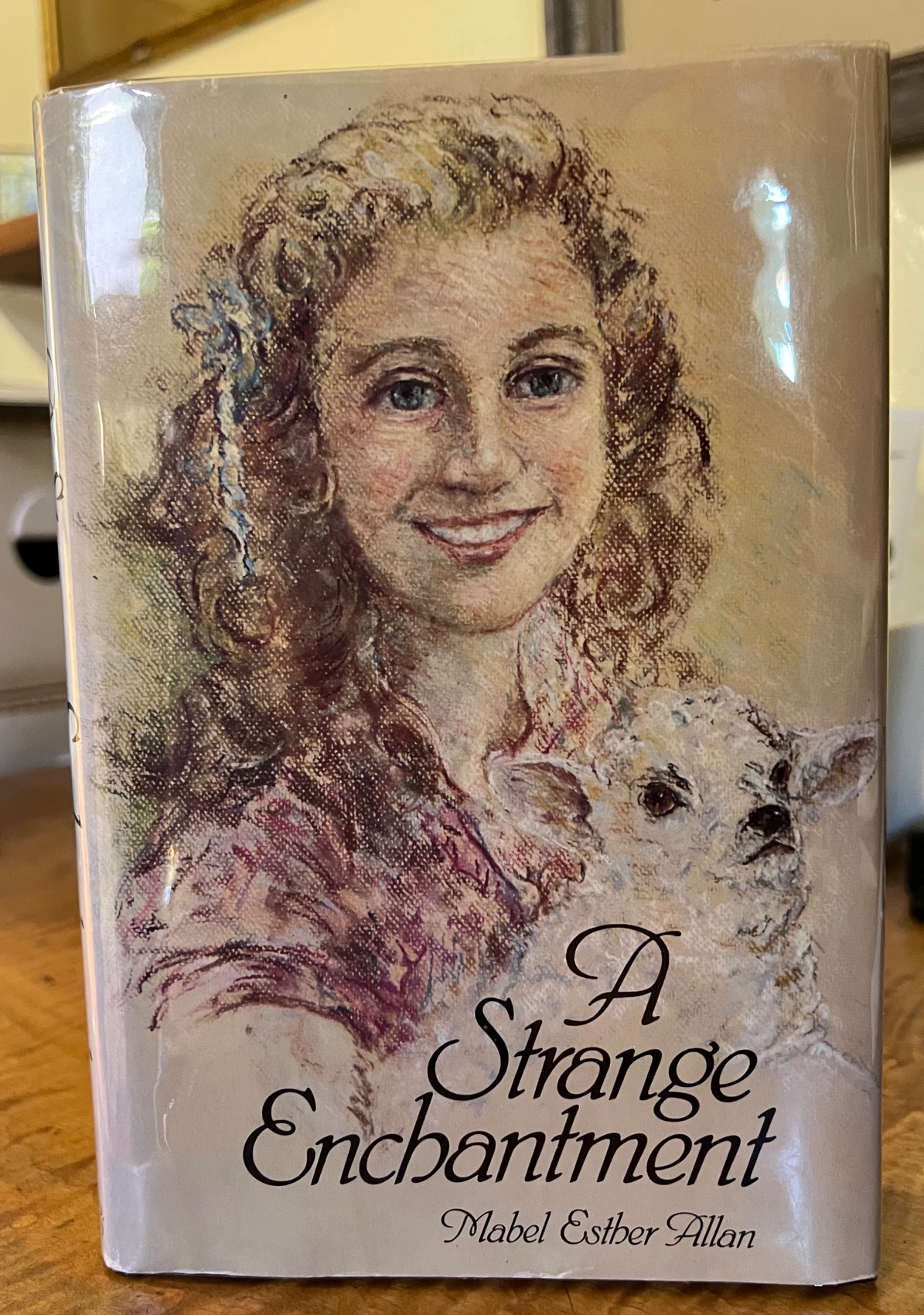
A Strange Enchantment
Mabel Esther Allan
Dodd, Mead and Company, 1981
A Strange Enchantment
Mabel Esther Allan
Dodd, Mead and Company, 1981
Description
[from inner flap dust jacket] It is 1939 and Prim, sixteen, is too young to join Britain's armed services. So she tacks a year to her age and volunteers for the Women's Land Army. She is sent to an agricultural college for training before going to work on a farm.
City-bred Prim has always thought of the country as a romantic place where cattle graze peacefully and new-born lambs frolic in the summer fields. In that first, bleak, cold winter of World War II, Prim and her new friends Jane and Hilary are given a foretaste of hardships to come. They tell themselves life on a farm can be no worse than life at the college, but they are in for some shocks as they struggle to bring in the all important harvest of 1940.
When Prim is eventually assigned to a farm in Shropshire, she is dismayed to find an instructor from the college living in the area, an instructor who had made Prim's life at school miserable because he thought her frivolous and totally without the makings of a Land Girl. But as they are thrown together, they begin to change their minds a little about each other.
In spite of the hard life and the dreary war outlook, Prim finds her heart lifting as she bottle feeds a tiny lamb, nestles her cheek against a cow's warm flank while she milks it, sees the comforting progression of the seasons over the English countryside...all this, for her, a strange enchantment.
Notes
Mabel Esther Allan (1915-1998) was a prolific British writer (at least 170 titles) of books for children and young adults. She wrote under her own name as well as Jean Estoril, Priscilla Hagon and Anne Pilgrim. She had poor eyesight, which interfered with her education and she never married. My sister and I are surprised we never encountered any of her work — especially her ballet-focused Drina series in any of our library-discard-sales childhood scavenging. Maybe she didn’t make it over the pond as much or maybe the timing wasn’t quite right. In any case, I know very little about her. I found a blog someone began about her work in 2010 — I wish it had gotten a bit more off the ground. It references a Mabel Esther Allan Goodreads reading group?
A Strange Enchantment is positioned, per a 1982 review, as being for readers 12-14 years old, and I know I would have enjoyed it at that age — but I enjoyed it at this much more advanced one, too, and feel like I appreciated its quieter, more serious notes in a way that I couldn’t possibly have then. Primrose may be 16 — and she does feel authentically so — but it still is clearly Mabel’s voice we hear through her: Mabel from the vantage of her 60s, looking back at her experiences “in the Women’s Land Army, from icy winter days at Cheshire’s Reaseheath Agricultural College to farms in Chesire and Shropshire.” (Liverpool Echo, Wed, Dec 22, 1982) I love these kinds of novels — we’ve profiled several of them — that are a kind of working through of their author’s war experiences, especially since women, both as veterans and as homefront workers, had far fewer opportunities for the memoir treatment than did their male contemporaries. We really do have to look more to fiction for accounts of their service. Like other such stories we’ve discussed, A Strange Enchantment is infused with grief and loss, but it also honors young women’s personal growth, celebrates the deep friendships they forged, and doesn’t shy away from the darker aspects of their circumstances — the war, of course, but also the gender and class-based injustices they witnessed and endured. Primrose finds much of her farm labor difficult and disillusioning, but she is proud of her unexpected fortitude and of her increasing strength and competence. She struggles to put words to the “queer fascination of hard work against the odds” (59) the sense of “living, as I felt I never had at home” (53) and the moments of, yes, “strange enchantment” to be found in the seasons and rhythms of country life: “walking the bull down the avenue before dawn, feeding the little khaki ducks in the rainbow light.” (79) Her friendships with the older (35!) more sophisticated Hilary, with her “bored, deep voice” (30), cursing, and acid comments and Jane, the girl from the orphanage, intended for service, who displays a quiet intelligence and surprising depth are highlights of the book and it passes the Bechdel test a hundred times over. Prim’s growing understanding of the inequities in agricultural labor at the time — the lack of protection for farm workers, and the attendant abuse, poverty, illness and insecurity — is an undercurrent throughout, despite the fact that, as she notes, “they had left politics out of it” (100) at the university. The romance, an enemies-to-lovers take isn’t especially original (I actually got the sense she was doing a YA take on one of Berta Ruck’s land-girl stories -- Jade Earrings -- here) but it is believable and kind of lovely.
A 1981 review describes A Strange Enchantment as a “down-to-earth story…told with realism and warmth” (Herald Express Sat Feb 21, 1981) and that pretty much sums it up. (The Philadelphia Inquirer, for its part, comments tartly that “it is certainly pleasant to read a book about a teenager who is not suffering because of divorced parents.” (Sun Jul 11, 1982) — Were they really all that? :D) I recommend it. Would adapt beautifully for film.
Tags
1940s, 1980s, English, Europe, England, YA, age difference, artist, beautiful/handsome, college/university, coming of age, determined, escape old life, f/m, farm, farmer/horticulturalist, female, filmed, should be, first-person, hair, dark, hot-tempered, idealistic, independent, inherited a child/instakid, intelligent, landgirl, lovers, enemies to, moving to the country, one woman has hurt you, recommended, romance, sexist, single, strong f/f friendship, teacher, war, womanhater/manhater, young
Flags
None