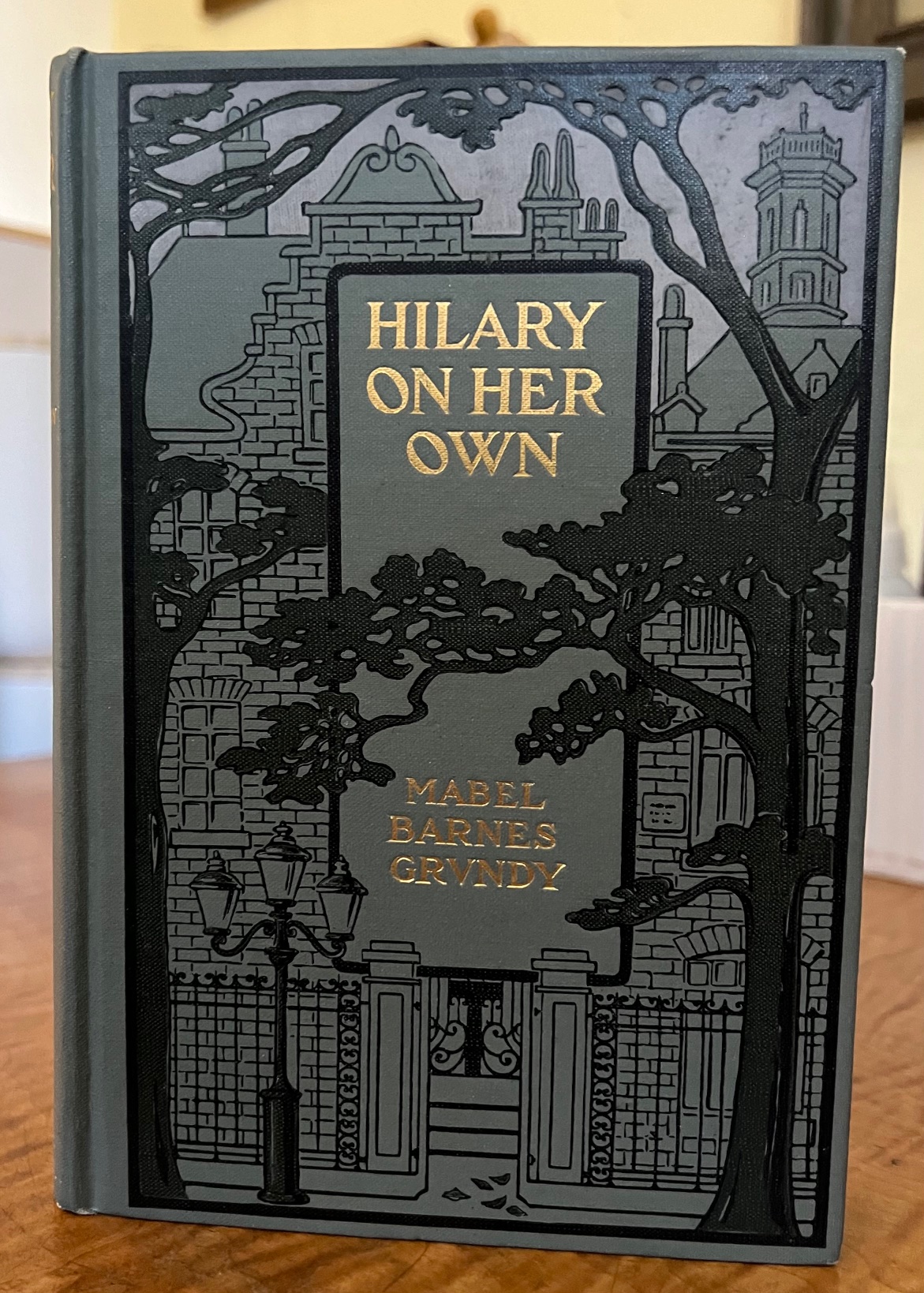
Hilary on Her Own
Mabel Barnes-Grundy
The Baker & Taylor Co., 1908
Hilary on Her Own
Mabel Barnes-Grundy
The Baker & Taylor Co., 1908
Description
[from review in The Cincinnati Enquirer, Mon, Oct 5, 1908]. Hilary, a clever and original English girl, living in a quiet country house in Derbyshire, and having nothing much to do, grows weary of her somewhat monotonous existence and decides that "to be penned up with one's family, however virtuous that family may be, is not for the good of one's soul." One day she explodes a bomb-shell in the family circle by announcing that she is going to London to earn her own living, a thing that no member of that highly respectable establishment has ever been required to do. That she does not find it altogether a primrose path goes without saying but she wins her way, and we knew she would, and does not regret her experiment. The book, which is especially a book intended for girls, is very brightly and pleasantly written.
Notes
Mabel Barnes-Grundy loves writing about restless, prickly girls who chafe at the bonds of family life and gender expectations and this seems to have been because she, herself, was one. In an interview excerpted in “The Daily Telegraph” (Tasmania, Australia, St., Dec 12, 1908) shortly after Hilary’s publication, Barnes-Grundy talks about how her latest novel is “something of an autobiography”:
”Like so many girls in these days,” she says, “I tired of my pleasant, comfortable, though unexciting home in the north, and literally arrived with a five pound note in my pocket to conquer London. I was extremely happy in my work, too, and only gave it up at the end of two years to marry.”
The article goes on to praise Hilary On Her Own as an antidote to the “unpleasant, dreary side of the working girl’s life” so often portrayed in fiction and, indeed, Hilary is dedicated “To Aunt Emily and Lallie, In memory of my brief and most happy working days in London”. Of course, it’s only fair to point out that Hilary, like her other job-seeking girl characters (she returns the theme with Whiff in A Girl for Sale, etc.), worked from interest, not necessity, and could, quite literally, afford to be choosy about their place and conditions of employment. That said, her depictions of “the pleasanter side” of working life — independence, social freedom, a sense of competence and accomplishment — offer a model to her young, educated middle-class readers who find themselves soul-cramped (Hilary’s nothing if not dramatic) “by the narrowness and smallness and sameness of things” (4), at home and who “don’t want to vegetate like a turnip in a field until someone comes along and removes” them (10) into another kind of domesticity — matrimony and motherhood. Hilary speaks from a place of privilege, certainly, but her plea “I am not obliged to work for my living, but please do not cease to be interested on that account.” (121) shows women at the turn of the 20th century, both feeling like they have to justify their desire for independence AND their willingness to stand up and do just that.
The book’s not perfect — Hilary’s character is a bit, for 22 years old, I don’t want to say ditzy, but she certainly talks a lot of inconsequence — kind of Carole Lombard in "My Man Godfrey" (the NYT review calls her ‘elfish’) — the hero is at times jarringly backward in his views on women (and a bit dramatic himself) and the deux ex machina that resolves their big misunderstanding is kind of eye-rolling. But Barnes-Grundy’s writing, as always, has humor and charm, there are franker discussions of real issues than you find in many of these light novels (cancer, alcoholism, sexual harassment in the workplace, gendered wage disparity, suffrage, the way social norms blight young women’s lives…), and strong depictions of female friendship. There’s also some fun treatment of health cranks that she’ll revisit in Sleeping Dogs. Overall, the NYT review’s pretty much spot on: “The subject is hackneyed enough, but the tale is written with a freshness of touch and a constant liveliness of fancy that make it entertaining.” (The New York Times, Oct 23, 1908)
Flags: discussion of alcohol abuse, suicide, n-word used in expression, anti-German sentiment
Tags
1900-1909, 1910-1919, English, Europe, England, age difference, cheerful, coming of age, competent, determined, doctor, escape old life, f/m, female, first-person, humorous, insurmountable barrier, intelligent, middle-aged, moving to the city, personal growth/becoming a better person, practical, prosperous, reserved, romance, secretary, selfless, single, spirited, strong f/f friendship, young
Flags
alcoholism/drug addiction or abuse, insensitive or outdated language (race/ethnicity/disability/sexual orientation), insensitive racial/ethnic portrayal/stereotyping, suicide