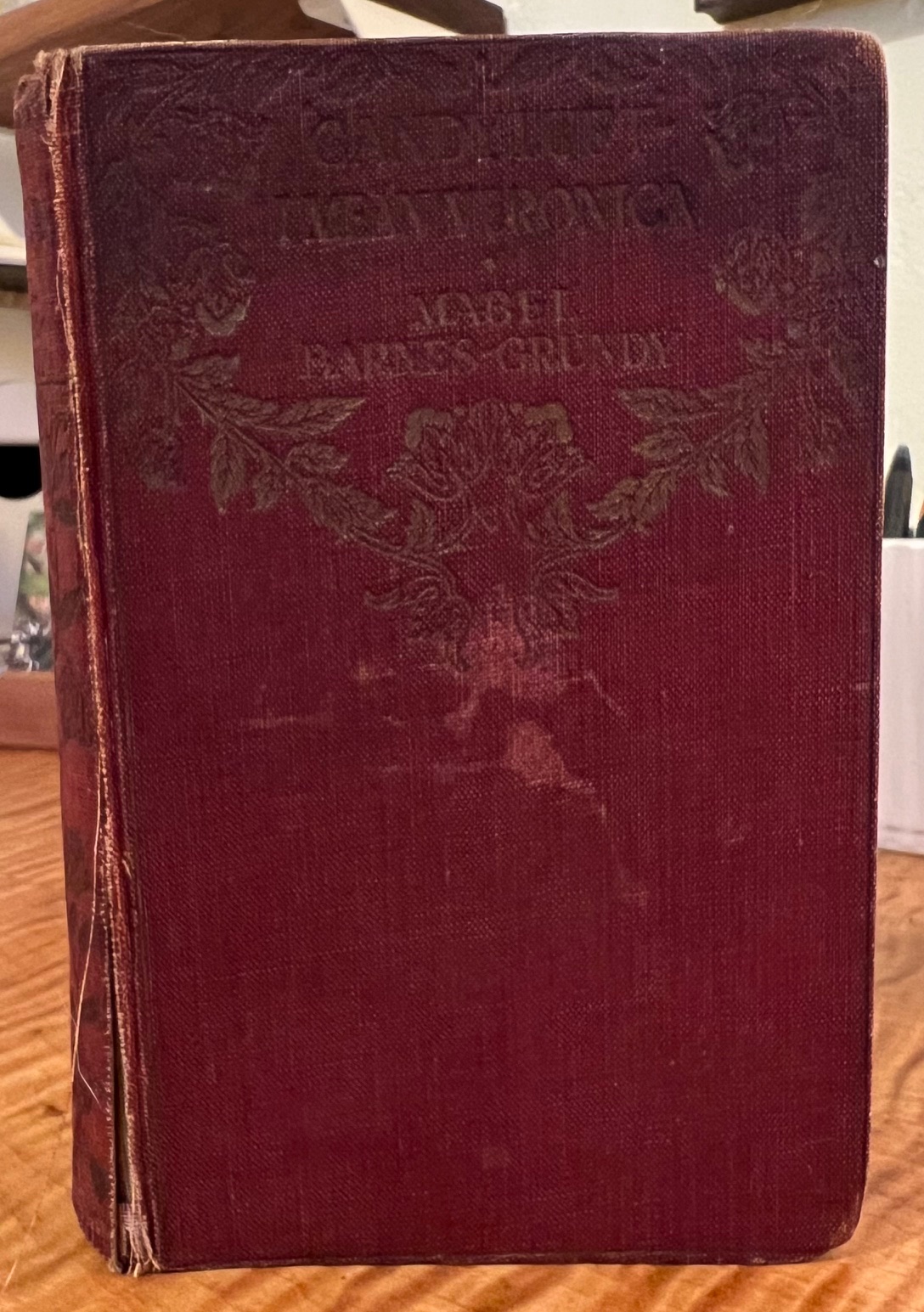
"Candytuft -- I Mean Veronica"
Mabel Barnes-Grundy
Hutchinson & Co., 1914
"Candytuft -- I Mean Veronica"
Mabel Barnes-Grundy
Hutchinson & Co., 1914
Description
[from review in The Birkenhead News and Wirral General Advertiser, Sat, Jan 2, 1915] The many admirers of the author of "The Third Miss Wenderby" will turn with delight to her new book. And they will not be disappointed, although we cannot promise that they will meet in these pages anybody quite so delightful as the delicious and audacious Diana Wenderby. Nevertheless Candytuft, Mrs. Barnes-Grundy's latest heroine is an exceedingly charming young woman, full of unconventionality and with a downrightness of character which is delightful. She never by any chance calls a spade an agricultural implement. Candytuft, on account of her parents -- themselves a charming couple -- allowing her name to degenerate into "Candy" or Tufty" for short, changes it on her seventeenth birthday to Veronica, and thenceforth insists upon that appellation. She has to fight for the name, as she has to fight for many things, including her own happiness. She is blessed, or the reverse, with an artistic temperament, which after her marriage threatens to bring shipwreck to the happiness both of herself and her husband, whom she dearly loves without fully realising the fact. They are saved, however, by one Tony Westerton, who by practising an elaborate hoax on Veronica disgusts her with him and teaches her to love and appreciate her own nice husband. The tale is told with rare artistry, and many amusing and real live characters are introduced. Mrs. Barnes-Grundy is a mistress of the art of rendering conversation naturally, and her pages sparkle with flashes of wit and shrewd observation. This is eminently a book to be read, and even in these times we predict for it a large company of readers.
Notes
Even though I'm so partial to Mabel Barnes-Grundy, at first I didn't think I was going to like Candytuft. The title character is, for the first hundred or so pages, really kind of awful. Fancying herself an intellectual and an artist, she openly disdains her kindly but commercial (dad's a "wholesale provision merchant" specializing in chit'lings) parents, and her handsome, adoring if unimaginative husband, George. Once I realized that CIMV is not the heroine, per se -- that what Barnes-Grundy is writing is actually romantic farce with accent on the latter, things picked up a lot. MB-G is at her best when she's poking fun at the foibles of her generation and day, and the usual suspects -- health faddists and medical humbuggery, the "artistic temperament", etc. -- get their gentle roasting. It's less taming the shrew than giving the artiste a taste of her own pretension, and women are otherwise treated as intelligent and fully capable throughout. The fundamental truth about their situation, that "Every law, every custom has been framed, evolved by man for his own convenience and happiness" (84) isn't belittled or explained away, either, which I love to see in these early-20th century novels -- you can really feel the suffragism in the air. Overall, though, it's just silly fun, with everyone trying to outwit everyone else, with disguises and faux flirtations, runaway girlfriends and acerbic servants, and always and everywhere, Shakespeare Waddilove, bouncing around, "declaiming like an orator", trying to reform Veronica and win himself a wife.
Candytuft -- I Mean Veronica seems to have been the only one of Mabel Barnes-Grundy's novels to have been filmed, in this case as a 1921 silent starring Mary Glynne (Candytuft/Veronica), George Relph (George Anstruther), and Leslie Faber (Tony Westlake). It's not clear how faithful the treatment was, if the one-line description in IMDB is accurate: "A man cures his ambitious wife by faking an affair with his friend's wife." That's...not really the story. Or, at least, not the main of it.
There's also very little biographical information about Mabel Barnes-Grundy available anywhere I've looked. Scott at Furrowed Middlebrow mentions this, too, and a commenter to that post, Andrew Stewart MacKay, provides the most information I've seen online about her, writing: "Mabel Barnes Grundy is cousin-by-marriage to my grandmother. We believe she was born in 1869 but sometimes she gave her year of birth as 1880! Her first husband is a relative of mine: a scientist called Frank Barnes Grundy (1871-1910) and they lived at 1 Helena Terrace overlooking the River Thames at Richmond. They had no children. I vaguely knew she later married a diplomat. Sadly we have no photos of her!" and, later, "To update: Mabel Barnes Grundy's mother was born Sarah Goddard of Park Hall in Staffordshire, and Mabel's father John Gaskell was one of the Gaskells of Clifton Hall in Lancashire (so perhaps a relation of Mrs Gaskell?). As such was a cousin of Lord Clive of India and a descendant of Thomas Goddard, Director of The Bank of England. Mabel and her first husband - Lecturer in Chemistry at The Royal Navy College, Greenwich - Frank Barnes lived at The Red House in Richmond-upon-Thames."
Flags: One character is disguised in a fat suit and his physique is portrayed as part of his ridiculousness.
Tags
1910-1919, English, Europe, England, accountant, athletic, beautiful/handsome, comedy, disguise, dominant, f/m, family home, female, generous, identity, concealed, illness acute , intelligent, kind, loyal, marriage, saving, married, moving to the country, nervous breakdown, personal growth/becoming a better person, romance, rural, selfish, spirited, spoiled, strong f/f friendship, strong m/m friendship, taught a lesson, third-person, unimaginative, young
Flags
body negativity