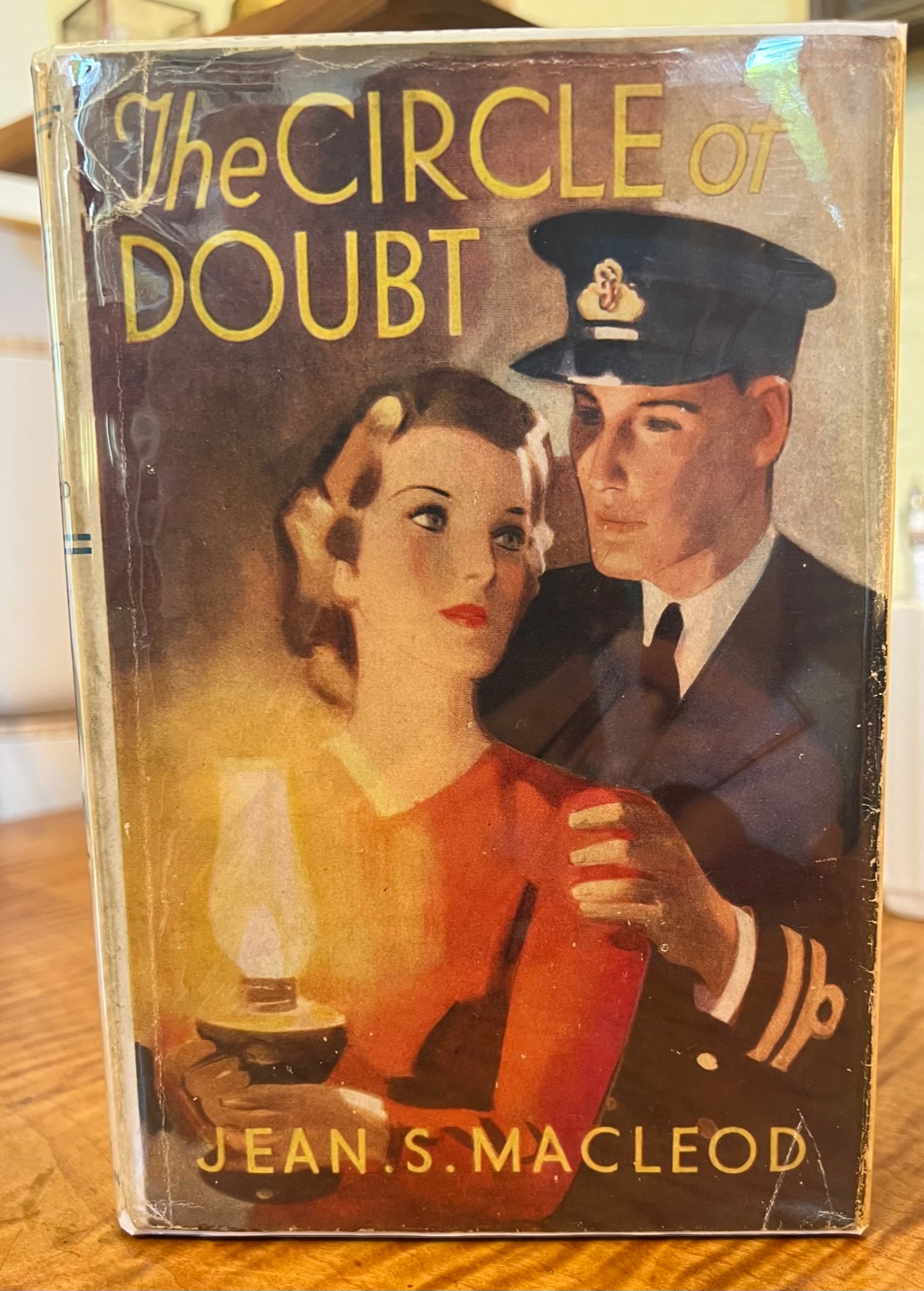
The Circle of Doubt
Jean S. Macleod
Mills & Boon Limited, 1943
The Circle of Doubt
Jean S. Macleod
Mills & Boon Limited, 1943
Description
The small Scottish island where Fiona Cargill has spent the last three years as a schoolteacher seems a world away from the war, but when a wounded soldier rents her friend's cottage to recuperate, Fiona finds herself drawn to the reserved young man. Then a naval base on the neighboring island is attacked and Fiona's neighbors begin to mutter about a light they saw that night on the shore just off the cottage -- a light that may have been guiding the German bombers in. Will Fiona's feelings for Hugh survive her growing doubts? What is her duty to her country -- and to love?
Notes
One of our collection's focuses is on early Mills & Boon -- for their wonderful dust jackets, especially -- so expect to see a lot more of these titles coming up!
The Circle of Doubt is, like so many Mills & Boons, a quick and enjoyable read. The plot isn't especially suspenseful, but Jean Macleod's love for the Scottish islands she writes about shines through every line, from her painterly description of the landscape and seasons to her affectionate, empathetic exasperation with the older generation of villagers. She returns over and over to the simplicity of existence in the quiet backwaters of island life. "We have to find contentment in the simple things on the island" (40) Fiona explains and, at home on a day off from teaching, she abundantly does: moving around the house "performing the simple tasks she loves" (39), going for a leisurely swim in the cove -- "sensation of warmth in the cool water" -- and looking ahead to a glowing peat fire in the evening with knitting to be done in its mellow light. One of the loveliest descriptions in the book is of the girls' attendance at a ceilidh (this was new to me) and the deep emotion they feel at the older women's waulking songs. But, under this all tranquility, is the current of strain that is the war. At the gathering "the young, bright-eyed faces had gone, the youthful voices were silent" and there would be no dancing. In a sense, all these war books are a break from genre convention. They're necessarily "happy for now": the payoff is, as in Circle, enough leave for a hurried wedding and honeymoon, but then -- unless he's sufficiently disabled for home intelligence work -- it's back to active service for the male mc and back to work and worry for the female. Macleod and her fellow authors are honest enough to not promise an HEA -- even in their heroine's "feelings" (though, occasionally, her prayers). At the ceilidh, the "laments on the pipes" and the old love song "like a sigh across the wind" (123) cut deeper for Fiona than they ever have before and it nearly brings her to tears. In the end, she and her soldier will take their tomorrow and just not look beyond.
One thing I really appreciated about Circle is its strain of quiet feminism. Fiona's and her best friend Cathie's relationship is, in many respects, the emotional core of the book, and both girls are educated professionals (Cathie is a district nurse), independent, and self-reliant. The men they grow to love respect them for their competence and courage and don't try to save them from the dangers of their work as the war becomes local: in fact, they admire them for their stubborn commitment to it. Macleod is most explicit about this in her depiction of one of the book's most admirable characters, a strong, principled young woman who farms with her brother. Mary MacNeil is openly critical of men's stewardship of world affairs -- "Could you imagine women sacrificing life like this..?" -- and a male character learns, to his deep interest, that: "she had her own views on woman's place in the post-war world, in spite of her quiet manner and domestic talent." (82)
Worth reading and thinking about.
Flag: There is a boy on the island, one of Fiona's students, who has a developmental disability. The villagers' language for, and treatment of, him is insensitive but Macleod makes it clear that this attitude is wrong -- Fiona objects to it clearly and strongly on more than one occasion.
Tags
1940s, Europe, Scotland, Scottish, big, brave, courageous, can't help loving you/love despite, competent, determined, duty before love, engineer, f/m, female, hair, dark, independent, intelligent, island, practical, principled, reserved, romance, single, soldier, strong, strong f/f friendship, suspense, teacher, third-person, unreadable to other MC, war, wounded, young
Flags
None