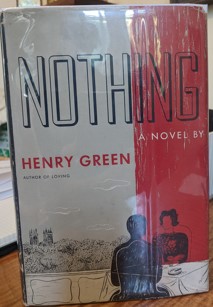
Nothing
Henry Green
Viking Press, 1950
Nothing
Henry Green
Viking Press, 1950
Description
(from dust jacket flap) Henry Green describes his new novel Nothing as "a frivolous comedy of manners" to which we also add that it is a portrait of postwar society in London's Mayfair and the love story of a well-to-do middle-aged widower who has a marriageable daughter, and a widow of the same age who has a marriageable son. It turns conventional attitudes topsy-turvy and shows up the "older generation" for what it really is.
Also, it is done, like Loving, with wily humor and filled with absurd and ironic situations and once again the author's dialogue has: "A fine, true breathlessness and furnishes much of the bone of the story...a cunning blend of idiom and poetic overtone." -- The Saturday Review of Literature.
Notes
A darkish comedy, as described above, mainly in dialogue and about the conflict between two generations who have, for good or bad, been shaped by their radically different formative experiences. Nothing reminded me, in sentiment, if not specifics, of M J Farrell/Molly Keane's Treasure Hunt. Both authors, interestingly, were closer to the age of the older characters in these novels (Green was born in 1905; Keane, in 1904) and they skewer their own generation with happy malice: having come of age in the flush and free-spirited 20s, the elder characters remain whimsical, charming, massively self-absorbed, and constitutionally incapable of accommodating themselves to their straitened and chastened historical circumstances. Contrasted, (as mercilessly, in Green's case) is the young generation, whose outlook has been pinched and crabbed by the deprivations of postwar austerity. Serious and practical, at the cost of imagination and romance (though, honestly, neither of those come off well here) they are conventional in their thinking and tastes, and personally conservative, whatever their politics. Damaged by the older generation, and at the same time resenting and excusing them, some of the young characters' lines feel awfully contemporary: "They all ought to be liquidated" he said in obvious disgust. "Who, Philip?" "Everyone of our parents' generation." "But I love Daddy." "You can't." "I do, so now you know." "They're wicked darling" he exclaimed. "They've had two frightful wars they've done nothing about except fight in and they're rotten to the core...They're so beastly selfish they think of no one and nothing one but themselves." Could be Millenials re. Boomers -- so Green obviously gets the essence of the generational divide right. No one's really sympathetic here, but if you like your characters down-at-the-heels posh & petty and would love to spend a few hours as fly on the wall for their gossipy machinations, this one's for you. (Spoiler alert: Keane, at least, lets her young people win.)
Tags
1950s, English, Europe, England, beautiful/handsome, cheerful, clueless, comedy, determined, f/m, family, parent, domineering, male, middle-aged, parent, romance, scheming, second chance, selfish, third-person, widowed, young love, discouraging
Flags
None