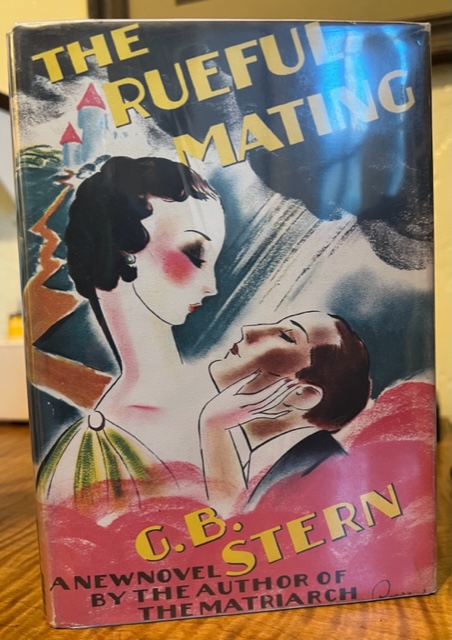
The Rueful Mating
G. B. Stern
Alfred A. Knopf, 1932
The Rueful Mating
G. B. Stern
Alfred A. Knopf, 1932
Description
[Phoebe H. Gilkyson in The Philadelphia Inquirer Jul 2 1932] [Published in Great Britain as Little Red Horses]
Halycon Day's mother was as sentimental a woman as her child's name indicates. Upon her death, when Halcyon is 11, her English sea-captain father arrives in New York to claim his little girl, and finds her an infant prodigy, a child-poet who gives public readings of her verse, a spoiled darling of the spot-light. Horrified, he abruptly carries her away from adoring maternal relatives and takes her to his sister in England.
His methods are as bad in their way as her mother's turgid ones. In a fox-hunting, out-door-loving countryside children who write poetry are considered "little beasts". Halcyon, who is actually better-read and more perceptive than the adults about her, is snubbed and scolded and made to feel an outcast until she stumbles upon a waif as odd as herself. Eden, a red-headed stripling of 12, supports a large family by his work on the stage. He is precocious in his knowledge of the world as Halcyon in her book-knowledge, and a strange powerful attachment develops between the two.
For the next few years the two think only of each other, scheming, plotting and lying in order to meet. Then a bitter quarrel -- no childish matter -- separates them. Their reunion three years later is a dramatic one...
Notes
I'd never heard of G. B. Stern -- this was another dust jacket buy. The Rueful Mating is really long -- 567 pages -- and odd, and more middlebrow than my preferred fare, and it follows two kids from ages 11 to 18...and I'm kind of astonished by how much I liked it. Contemporary reviewers agree -- to almost a one, they seemed to find they were drawn in and charmed despite themselves, and without really knowing what to make of this or even how to talk about it. The Chattanooga Daily Times finds it "touching and amusing, but vastly more satisfying than these terms may indicate" (Jul 10 1932) the Inquirer, "lively, humorous and moving"..."if one can reconcile his reason" to the characters, and the Lexington Leader review declares it "delightful" and "poignant" but "not of a type for wide-spread reading." (Jul 3 1932). The NYT, for their part, speculates that the project was a kind of holiday for Stern, from her more serious work (most famously, The Matriarch): "giving the impression that the author, grown tired of wrestling with the problems of earnest everyday existence, had wished to escape into a world where she could really enjoy herself, one might almost say a world of fantasy, were it not that 'fantasy' has an unpleasant sound and would be most unjust in the present connection" (Elizabeth Lyman Brown, NYT, Jul 3 1932)
So, what makes Rueful Mating so unexpectedly, unjustifiably, even, good? For one thing, Stern can really write and her descriptions -- of the seasons in the British countryside, of the "weariness of being children", of the details of daily life, etc. are insightful, incisive, and often beautiful -- "The elegant fall of her remarks was like one of those bead doorways -- you could push past them, but they impeded your progress with a reproachful tinkle" (251). For another, what she's writing about, she clearly knows. Gladys Bronwyn Stern may not have been a child prodigy, like Hal, but she published her first poetry at 17. She didn't have to work as a child, like Eden, but (per Wikipedia) her family lost their money in the Vaal River diamond crash and she grew up in "a series of apartments, hotels, boarding houses". She studied in Germany, like Hal, and a year before The Rueful Mating was published, had, like Hal, staged her first play ("The Man Who Pays the Piper"). Her affection for southern Germany feels so true, as does her funny and painful skewering of "the celebrity of genius", of popular movements in poetry (Hal's infatuation with Lambert Pryde the "Simultaneist"), and of whimsicality and symbolism in modern theater (Hal's dreadful "Archway" with its "quaint conceits of dialogue" and overstuffed imagery). Readers who were ever, as children, considered "smart" and "different" will see how absolutely she nails that experience, too: a child's dread of "losing" her talent where her sense of value and self-worth is completely tied to her status as unique & special & gifted; the desire to be accepted by your peers -- that "delicious healing orthodoxy" (180) -- and what she'll do (and who she'll betray) for it, and the feeling of confusion at being both celebrated and resented by adults around her.
While she has a sharp eye for detail, though, and a flair for satire, Stern's not out to get anyone. Like Hal, she's tolerant -- a little envious, even -- of the normies, and the book's full of good-hearted, well-intentioned people and strong friendships.
Eden is by far the most sympathetic character -- it couldn't be Hal, I think, because G. B. feels too close to her for that to be fair and true -- and he really is a character the reader grows to love and respect and want to protect -- from the world and even, for a time, from Hal. Their relationship -- two lost children recognizing in each other their one person -- the "end of the winter of [their] loneliness" -- is really just... lovely -- despite what the cynic would call its tremendous strain on credulity. There's really no way to do their love story, or this book, justice & I'm glad, from reading the 1932 reviews, that I'm not the only one who struggled.
Read it yourself! And tell me what you think.
Flags: Infertility. Portrayal of a few Jewish characters feels uncomfortable (Stern, however, was Jewish herself). Negative, stereotyped portrayal of a South American woman. One brief, clearly satirical scene displaying the racism/anti-semitism of an older member of the theater community.
Tags
1930s, American, English, Europe, England, Europe, Germany, United States, Northeast, actor, brave, courageous, celebrity, cheerful, child, childhood sweethearts, clever, clueless, competent, determined, f/m, family, parent, responsible for, famous, female, fish out of water, friend, selfless, generous, idealistic, independent, interclass, jealous friend/family member, lovers, friends to, opposites attract, personal growth/becoming a better person, poor, poor little rich girl/boy, principled, recommended, rich, romance, selfless, slight, spirited, strong m/f friendship, strong m/m friendship, third-person, writer, playwright, writer, poet, wrong side of tracks, young, young love, discouraging
Flags
infertility