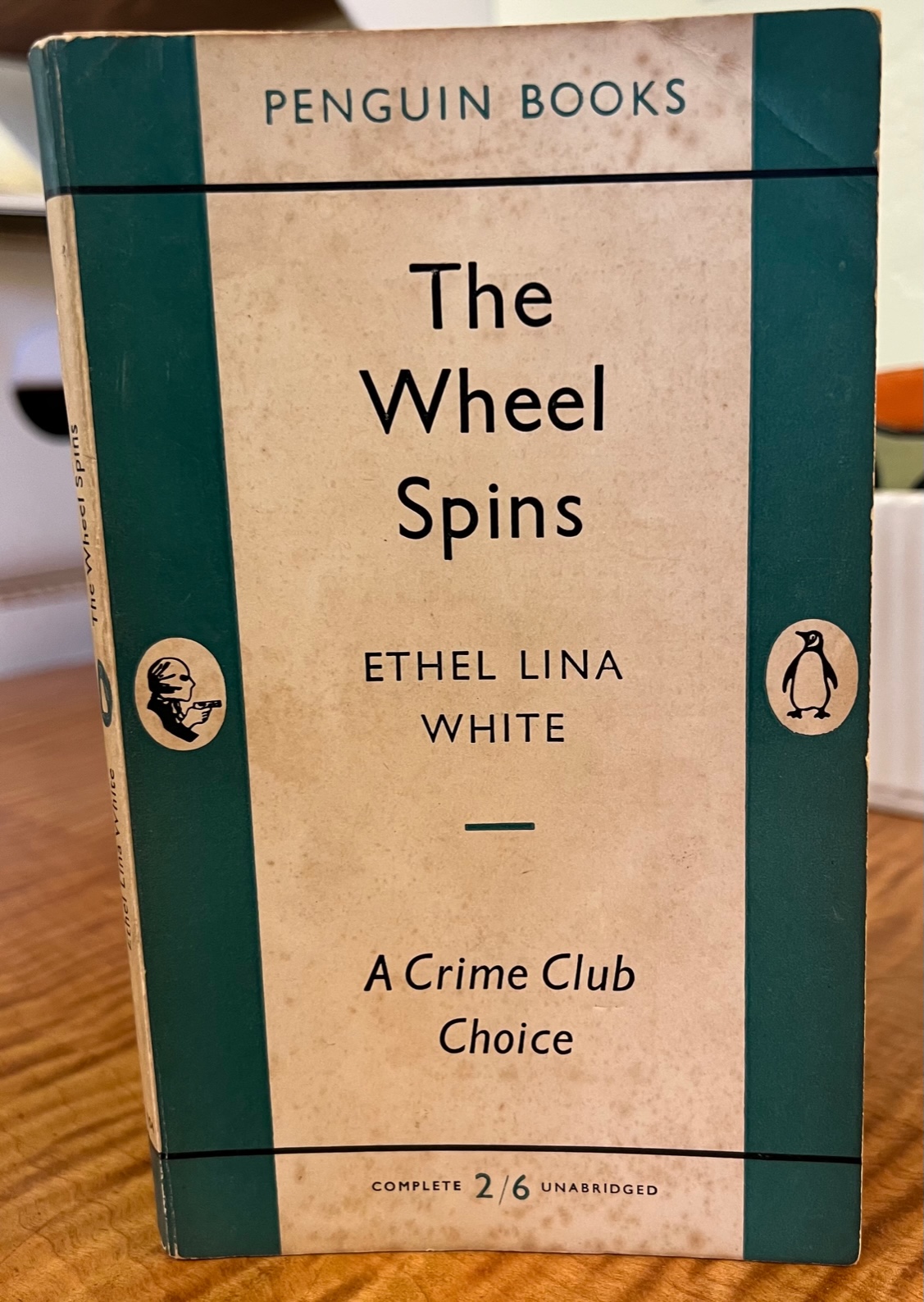
The Wheel Spins
Ethel Lina White
Wyman & Sons, Ltd., 1936
The Wheel Spins
Ethel Lina White
Wyman & Sons, Ltd., 1936
Description
[my edition Penguin, 1955] [from the Globe-Gazette (Mason City, Iowa), Sept 5, 1936]. Mystery Story on European Express. Ethel Lina White has written a mystery story with a new twist in The Wheel Spins. Most of the action takes place on the night express bound from a vacationing spot in Europe to Trieste and the leading character is Iris Carr. When Iris boards the train she finds as her traveling companion an English governess, Winifred Froy, who is returning to her home in England for a vacation from her duties with a ruling family in Europe. The two are the only English in their compartment. On the other parts of the train are English people whom Iris has known slightly at the resort at which she stayed.
Iris goes to sleep and wakes up to find that Miss Froy has disappeared. No one seems to be able to help her locate the woman. The other people in her compartment will not acknowledge that Miss Froy ever existed. A strange woman dressed in Miss Froy's clothes says that she is the one with whom Iris traveled. Panic-stricken, Iris tries frantically to get someone interested in the missing Miss Froy and finally succeeds in enlisting the help of a young construction engineer, named Hare.
The trio of them begin search for Miss Froy and Iris finds herself running into danger in the interest of the English governess whom she scarcely knows. Most of the people in the train conclude that she is crazy and at times Hare is doubtful about her. The suspense mounts with the action and the reader finds his attention racing along in the search for the vanishing lady.
It is possible that the famous story about the vanishing lady who disappeared from a Paris hotel may have had something to do with the plot of The Wheel Spins. Whether or not, the story is well handled and introduces a number of amusing characters in the fellow travelers on the night express.
Notes
The title of The Wheel Spins is not, or not just, about the wheels of the train on which the story unfolds, but also the wheel of fate, and the roulette wheel of hopes/fears/schemes on which the characters all stake their chances. It's nicely done.
Most of the contemporary reviews of The Wheel Spins were quite positive (though The Guardian grumped that the entire plot could have been avoided by talking to the conductor) with blurbs warning of danger to readers with high blood pressure -- on account of the "heeby-peebies" -- and The Daily Oklahoman declaring: "It unnerved us completely."
I wouldn't go that far, but Wheel was a fun read and you can see why Hitchcock picked it for adaptation as his "The Lady Vanishes". The movie is more exciting in a lot of ways than the book. It's less provincial in its plot -- unsurprisingly, given the international cataclysm Europe was ever more clearly racing towards in '38 (movie) than '36 (book). It's also less frustrating, as Michael Redgrave makes a delightful ally in the movie and Iris, in the book, is disbelieved by all until, virtually, the final chapter. Hitchcock also throws in a lot more welcome humor.
That said, the book has its points. It's more believable -- Miss Froy is much younger, for one, and there's no highly implausible shoot-out. Its framing is actually as much a story of Iris's personal growth as anything else. An "attractive orphan of independent means" (7), at the beginning she's spoiled, not particularly kind, and has relied on and taken totally for granted the "protective-square system" whereby her youth, beauty, and money have always shielded her from slings and arrows and the consequences of her own questionable choices. A brush with danger increases her awareness of this privilege but at first, her efforts to find Miss Froy are still motivated mainly by pique: it stings her ego to be so disbelieved. When Max says "You must be the most unselfish person alive", she's honest enough, with herself and him, to outright deny. But, slowly, over the course of her fight, Iris finds herself feeling real empathy for the missing woman and a determination to find her, whatever the personal cost. White does a good job of making Miss Froy, in particular, a character you feel for: ordinary, imperfect, even annoying, but loved and valued and fully worthy of all the trouble Iris eventually must take. Iris's growth is really in coming to appreciate this about someone outside herself.
As a woman there's an additional layer of chill in realizing how much of the disbelief directed at Iris was pure sexism and White really makes you feel her despair and danger in the face of it. It's worth a read just for that.
Now, I'm off to BritBox the 2013 BBC version, which is apparently a more faithful adaptation. I'll report back.
An aside: the book and many of the reviews (as above) refer to a well-known story about a woman losing her mother in Paris at the time of the Exhibition. Some describe it as a true story, others as a book or a movie. Is anyone familiar with the source of this? My only previous exposure is Marie Belloc Lowndes The End of Her Honeymoon (1913), but in that case, it's the young husband who goes missing. I'm going to poke around a bit in Newspapers.com.
Tags
1930s, English, Europe, beautiful/handsome, determined, engineer, escape old life, f/m, female, filmed, has been, forced proximity, intelligent, mystery, on the road, orphaned, personal growth/becoming a better person, political intrigue, rich, romance, selfish, single, spoiled, tall, third-person, train, young
Flags
None