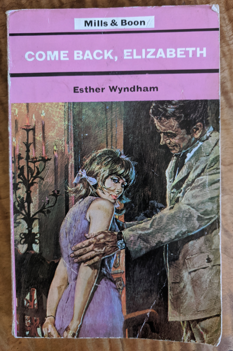
Come Back, Elizabeth
Esther Wyndham
Mills & Boon, 1948
Come Back, Elizabeth
Esther Wyndham
Mills & Boon, 1948
Description
Pseudonym for Mary Lutyens. Republished in paperback 1969. (from back of 1969 pb) Elizabeth Terry was a girl who had always thought she could get along very well without involving herself too much with men. For the present, she was far more concerned with the glamorous job she was taking on in New York. But fate, it seemed, had other plans for her -- in the shape of Seymour Delroy. She met him on the boat, helped him out in an emergency by acting as his temporary secretary -- and before they had even reached New York she had fallen in love with him. Then Elizabeth realised just what she had done -- for Seymour was far too wrapped up in his business affairs, not to speak of the highly suitable girl he was expected to marry, to waste a second glance on a mere secretary. Elizabeth knew that the most sensible thing was to get away from him -- but that was not going to be as easy as it sounded.
Notes
Let's start with the atrocious paperback cover. The male MC is supposed to be in his 20's and here he looks a seedy 50-something. If the cover reflects anything about the book at all, it's an unpleasant scene where, in anger, he grips female MC's shoulders hard enough to leave red marks (which, in the privacy of her room, she rubs her cheek "caressingly against") -- as grossly inappropriate behavior from a declared lover as from, still here, a boss.
The book reads like it's written for very young girls. Elizabeth has an all-expenses-paid trip to New York to model her whole-sale company's dress line. She doesn't get a bit seasick, everyone she meets is nice to her, the American department store owner gives her lots of dollars to buy souvenirs, and she goes window-shopping one afternoon and stops "two or three times" in drug-stores where she "indulge[s] in a malted milk shake with a great blob of ice cream on top of it."
The sexism is plentiful and overt, with Elizabeth's uncle and the male MC freely expressing their opinions on women and gender roles. Lines like " It seems ridiculous to you, but it's no more ridiculous than a woman being familiar with the differential calculus. Men and women should retain the mystery of their own spheres and not seek to encroach on each other's..." And this from her boss, who, already noted, is in his 20's.
We've not encountered attitudes this explicit in many earlier novels (1920's, 1930's). Is it that category romances from this mid-century period were aimed at young women without many career prospects who might find older norms validating? Is it some post-war domestic shift? In any case, Wyndham doesn't do a great job of making it go down easy. Some interesting reflections on the differences between life in England and in America, but not enough to really salvage it.
Flags: Beyond the sexism, Male MC often says he's going to work her like a slave, which, coming from the scion to a sugar fortune, is even worse.
Tags
1940s, English, Europe, England, United States, Northeast, beautiful/handsome, cheerful, department store owner/heir, determined, disability, threatened, dominant, f/m, family, parent, domineering, female, hair, blond(e), heir/heiress, idealistic, intelligent, model, named Elizabeth, ocean liner, reformer, romance, secretary, single, strong, tall, third-person, unreadable to other MC, workplace, young
Flags
None