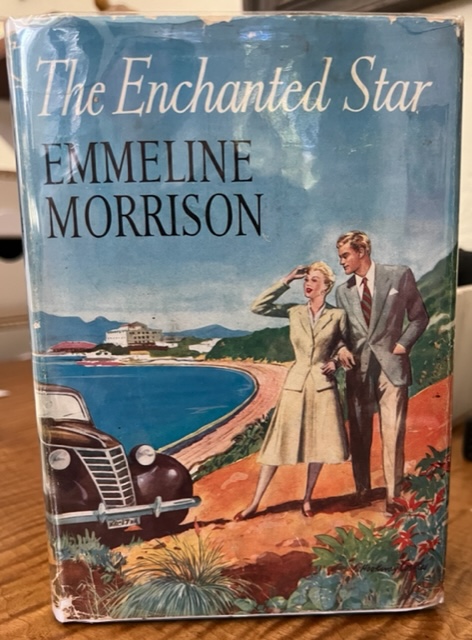
The Enchanted Star
Emmeline Morrison
Hutchinson & Co., 1954
The Enchanted Star
Emmeline Morrison
Hutchinson & Co., 1954
Description
[from inner flap dj] When Helena Adair loses her job as a journalist, she little thinks that she will find herself almost at once en route to South Africa, to take up a post as private secretary to the wealthy mining magnate, Mark Trevane; still less that she will so soon be caught up in a series of dramatic and mysterious adventures. Readers will be enthralled by this story of a women's relationship with two men -- of her feelings for the enigmatical Mark, despotic and seemingly cold, and for the attractive Julian Loveland, and of how, after a memorable year, she eventually finds happiness. The story, set against a vividly realised South African background, has the many qualities which have earned Miss Emmeline Morrison such a wide following.
Notes
The Enchanted Star starts out promisingly. It's 1946, in Helena's retelling, and she's 25 years old, and a journalist winding down an affair with a married RAF pilot (now demobbed). He got her a job on the paper he worked for; they parted without recriminations. She hates her job writing a woman's column and longs to do crime-reporting. When she's let go, the editor says she lacks the necessary experience, but that if she brings him a good scoop, he'll hire her back. All this is unusual for a book from this period, especially given that Helena experiences no negative consequences from her "indiscretion" or much pushback for her desire (eventually revised, of course) to put career before matrimony. And there are, indeed, vivid descriptions of South African cities and countryside at the time. Unfortunately, Helena, as main character and narrator, is just unpleasant -- unprofessional, unprincipled, and unkind. There's the inevitable racism with a side of anti-semitism, too. It's always interesting to see how British writers of this period understand ("grapple with" is too strong a term) Empire: here characters both acknowledge the devastation colonization has wreaked on indigenous communities -- the poverty is described as extreme and appalling -- and dismiss it. The South African vintner: "...time and civilization must be served and march on, and these changes are inevitable." Intermarriage is portrayed highly negatively, and the presence of non-Caucasian blood as causing women to be "oversexed". It's a shame because Star had the makings of a decent adventure-mystery. It should, imo, have had a more empathetic narrator, settled on the other male lead, and been about Nazi-hunting instead of whatever convoluted and bigoted thing this was. Skip and read her A Tale Untold (1956) instead. It makes more interesting use of a mysterious brooch, too! Flags: Racism, anti-Semitism.
Tags
1950s, Africa, South Africa, English, South African, athletic, f/m, farmer/horticulturalist, female, first-person, forthright, guardian/ward, hair, blond(e), journalist, lovers, enemies to, mystery, not recommended, romance, secretary, single, strong, tall, young
Flags
insensitive or outdated language (race/ethnicity/disability/sexual orientation), insensitive racial/ethnic portrayal/stereotyping, racism