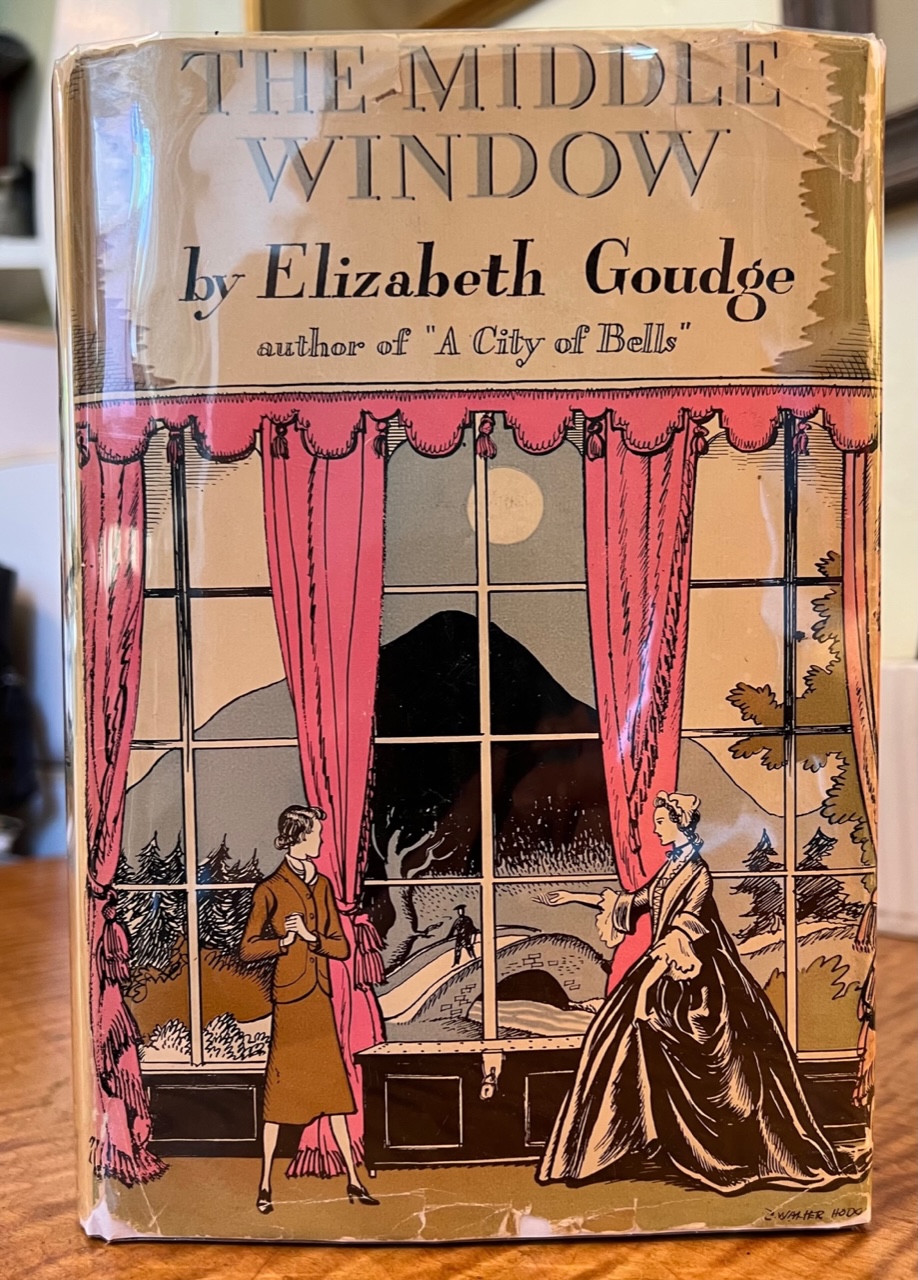
The Middle Window
Elizabeth Goudge
Coward-McCann, Inc., 1939
The Middle Window
Elizabeth Goudge
Coward-McCann, Inc., 1939
Description
[from inner dj flap] No one who has followed Miss Goudge's writing could ask for a more perfect blending of her remarkable talents than is to be found in this modern romance of the Highlands of Scotland and Skye. A story of today, it draws its inspiration from the '45, when the clans gathered under the banner of the Young Pretender. The novel opens with the arrival of lovely Judy Cameron at Glen Suilag and tells of her meeting with Ian Macdonald and his man Angus (surely one of the most crotchety and lovable servants who ever growled his way through a novel.
On a sudden whim, Judy had persuaded her father and mother, and Charles, her fiancé, to leave London for the North, and she had further persuaded Sir James, who was always putty in his daughter's hands, to rent, sight unseen, Macdonald's draughty Scottish manor. Sir James took immediately to the fishing in the loch, Lady Cameron complained alternately about the strength of the tea and the weakness of the plumbing, and Charles faded shortly into the background. Judy felt as if she had come alive for the first time. The brittle round of London society seemed like a dream. She was sure that she had always belonged to the Highlands. Ian Macdonald, of course, was one reason, but there was more to it than just the excitement of having aroused the interest of a handsome young Scot. Old Angus, the house in the glen, the loch, and the surrounding mountains, all seemed to have struck some mysterious chord in her memory.
And so Miss Goudge weaves her tale of Ian, Judy, and old Angus, a tale of a love and a loyalty which were too deeply graven for time to destroy. And as the modern story of Judy and Ian unfolds, another story begins to take shape -- a story of another Macdonald and his Judith, and of another Angus who polished a claymore with better will than table silver.
The idea behind The Middle Window is not new to fiction or to the theater. Berkeley Square used it to advantage, only a few years ago. The conception of a relationship so strong that it can survive the passage of the centuries has always fascinated the creative writer, but we doubt whether it has ever been put to a more fascinating use than here.
Notes
The first challenge in reading The Middle Window, at least for the reader over 30, is getting past the seventeenth century laird's oft-repeated name. It takes a concentrated effort to hear the inscription "Judith Macdonald, her book. Given to hear on August 18th, 1745, by her husband Ranald Macdonald." (96) and visualize proud and prosperous "Highland gentleman in tartans and a bottle-green coat" (54) and not...hamburger-hawking clown.
That said, as a young teen, I would have loved this book. The beautiful Judy, rebelling against her society life in London -- "just like an auction of painted dolls" -- finding love and mystery and a sense of self -- in the bleak, high Scottish glens. And her Ian, "A man lonely and emotional, imaginative and strong" (35), "shabby and diffident, marked by poverty and struggle, nervously conscious that everyone thought him a fool." And the tragedy of their forebears -- that march towards Culloden -- softened by a kind of Calvinist take on returning again and again -- "the cycle of renewal and suffering" -- until "perfection was an accomplished fact" (79): until you get it right.
Not being a young teen, I found the MCs a little annoying. Judy, so bossy, self-centered, and inconsiderate of the people around her who haven't gotten the call to mystical self-discovery. Ian, idealistic almost to the point of priggishness, intent on, quite literally, building a Utopia in Glen Suilag, protected by its high purple mountains -- one road in, one road out -- from the "filthy" "loathsome" (72) modern world.
In contrast, Judy's parents, fiancé and cairn terrier (we occasionally are gifted her perspective, too) and the old servant, Angus, are pretty much a hoot. The same story, told by these multiple narrators (skeptical and put-upon) would have been way more fun.
Worth reading, still, as an early entry in the recincarnation romance niche and for its kind of melancholy hopefulness about love and life and that "great windy darkness" that stretches we "know not where" and holds we "know not what". (50)
Tags
1700s, 1930s, English, Europe, Scotland, Scottish, already taken, beautiful/handsome, brave, courageous, coming of age, determined, doctor, dominant, eccentric/quirky/neurodivergent, estate, f/m, family home, female, heir/heiress, idealistic, independent, intelligent, landowner, love at first sight, moving to the country, nobility/royalty, noble/aristocrat, paranormal, personal growth/becoming a better person, political philosophy, poor, principled, progressive, quiet, reappearance of old love, redemption, reincarnation/love over lifetimes, rich, romance, single, spirited, stodgy fiance(e), strong, tall, third-person, young
Flags
death of mc