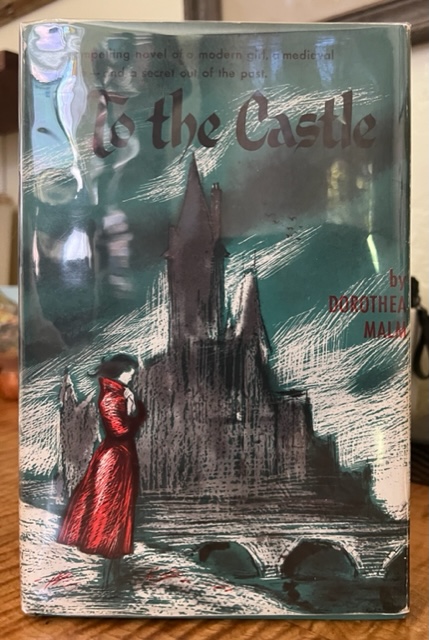
To the Castle
Dorothea Malm
Appleton-Century-Crofts, Inc., 1957
To the Castle
Dorothea Malm
Appleton-Century-Crofts, Inc., 1957
Description
[from inside dj, Book Club edition)
"The idea of being a bastard scarcely troubled me any more because my mysterious father was a duke who lived in a castle..."
Ancient, majestic, mysterious -- the castle beckoned to her -- as if it would reveal a secret out of the past. She had come to the castle empty-handed, asking nothing. But somehow she could not leave. She belonged to this place, whatever her American beginnings. Yet if she could have foreseen what awaited her at the castle, she might have fled in terror.
Isabel's slim height, her long elegant hands, the remarkable telltale line over the eyelid -- these things did not lie and they told her she belonged to the castle and to the Duc who owned it. The servants gasped when they saw her stand beside the Duc. No one would deny that she was his daughter, born out of wedlock.
And so Isabel remained at the castle to be captured in a chain of events that led to an inevitable and terrible climax. She remained despite the rejection of the fierce and handsome Duc who would not claim her. She remained despite her awful discovery about the recluse who lived in the castle. Was it the Duc who held her in his shame or his strange tenderness? Or was it Yves, who seemed to hold a weapon over them all?
A paper blown in the courtyard; a finger crooked around a door; a picture album with a clue to the past -- Isabel at last knew their meaning and where her own future must lie. The reader will be spellbound by the atmosphere of brooding suspense and excitement in this irresistible combination of romance and terror.
Notes
The narrative voice in "To the Castle" is interesting: it starts in first-person and then switches to third as she tells the story of a younger self who seems, to the narrator, like a different person: "Isabel at 21 puzzles and irritates me..." And you can see why the hindsight annoyance, honestly: reviews, and the dust jacket, compare the book to du Maurier and the young heroine really does give off a little of the same sympathetic-yet-exasperating naif vibe as "Rebecca's" nameless protag. The central mystery may be kind of underwhelming, but Malm writes assuredly and well and the setting's plenty atmospheric. Gothic elements are returned to a bit repetitively (the well, the possibly-haunted well) and red-herringly, too, but I have to admit, I enjoyed the whole package AND it went in a really unexpected direction, which I always love. It was also refreshing to have a French setting and characters who just are, instead of existing to be in constant contrast to the English climate, character, and temperament. Not sure why such low ratings on goodreads: it's divertissant.
Tags
1930s, 1950s, American, English, Europe, France, French, beautiful/handsome, blackmail, blood will tell, can't help loving you/love despite, castle, coming of age, determined, escape old life, f/m, family, eccentric, family, parent, abusive, family, parent, death of, female, first-person, forbidden love, gothic, hair, dark, hot-tempered, identity, mistaken, illegitimate, mystery, naive/silly, romance, secretary, tall, thin, third-person, young
Flags
child abuse, suicide