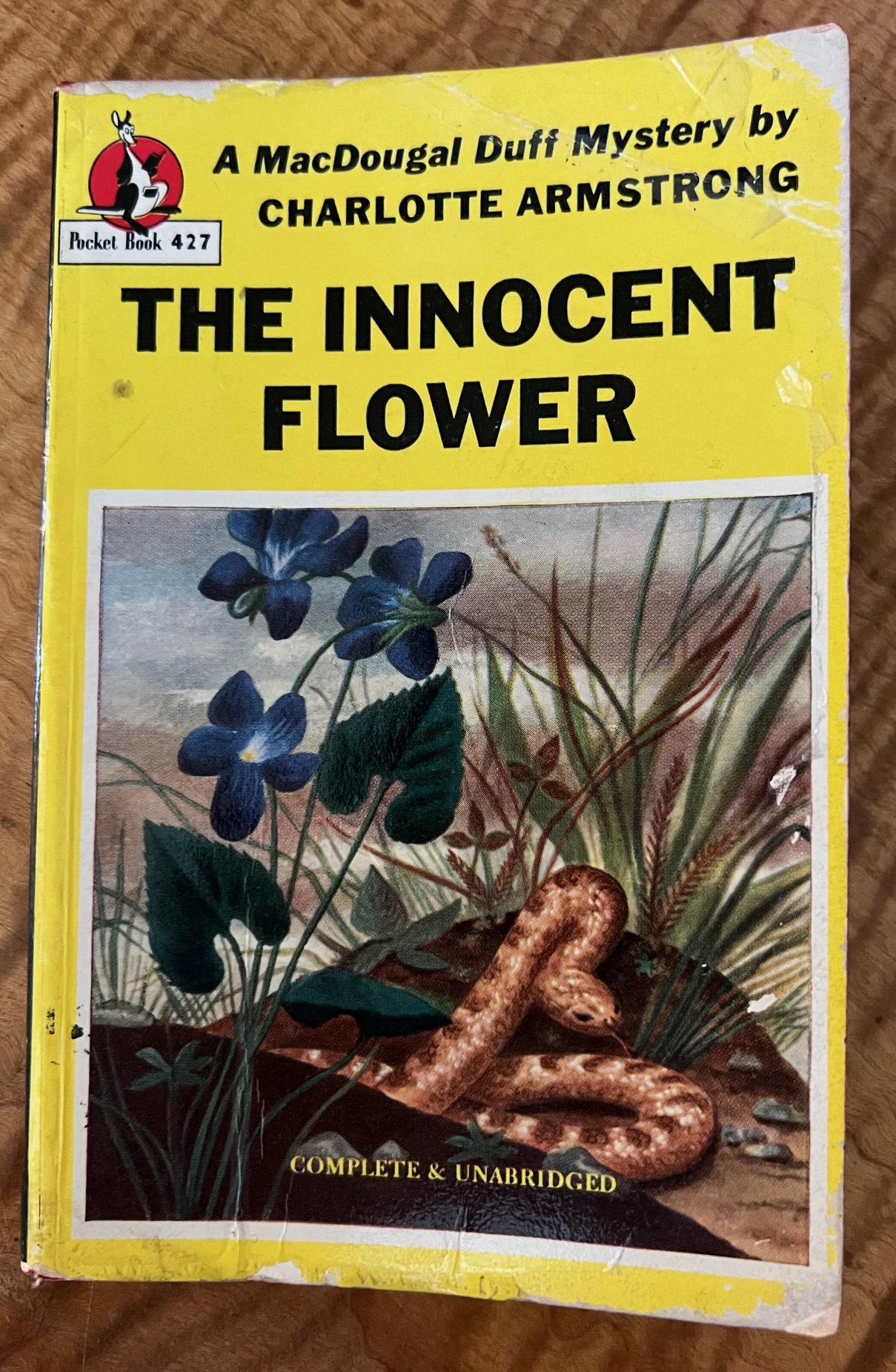
The Innocent Flower
Charlotte Armstrong
Coward-McCann, 1945
The Innocent Flower
Charlotte Armstrong
Coward-McCann, 1945
Description
[from back of Pocket Book edition, 1947]
A Child's Garden of Murder
"LOOK LIKE THE INNOCENT FLOWER, BUT BE THE SERPENT UNDER 'T."
The next-to-youngest of the six lovely Moriarity children was "The Rose of the World" to the famous detective MacDougal Duff. But in the Moriarity house, a woman was dead -- murdered. And the six children and their serenely charming mother presented a solid front against the rest of the world. Duff was afraid. They were hiding something -- or someone.
This unusual mystery is peopled with frighteningly wise children, a cold, hard woman, a mysterious newspaperman, and a haunted, driven murderer. Among them all moves Duff, baffled and anxious. Trying desperately to understand the situation, confused by his own emotions, he is forced to advance slowly. And when the time for action finally comes, he is almost too late.
Notes
Charlotte Armstrong Lewi (she wrote under her maiden name and also as Jo Valentine) published 29 novels, a few plays, and many short stories between 1939 and her death in 1969. At least three of her novels were filmed. She is considered, per Wikipedia, a “pioneer of domestic suspense” and her work is marked by a liberal-minded political sensibility (she wrote against “mob rule”/McCarthyism), and “a strong sense of family”, with “romantic love…a by-product…but not the main action.” (Jane Gottschalk in Romance and Gothic Writers, 1982)
The Innocent Flower was Armstrong’s third novel and the last in her mystery trilogy starring retired history professor and renowned amateur detective MacDougal, “Mac”, Duff. It’s the kind of mystery I love: smart, literary, Golden-Age (or Golden-Age-flavored) whodunits featuring cerebral, bachelor detectives who find themselves perturbed, unexpectedly, by the call of heart over head. Think the Wimsey-Vane tetralogy. Think Innes’s Appleby’s End. (If you think of others, let me know!)
Flower is a nice addition to the genre. It’s well-written, twisty (I fell for a red herring or two) and populated with appealing personalities. On the back of the opening “Cast of Characters” page, she writes that “three of the children in this story are roughly drawn from three real children of my own” and a Green Bay Press-Gazette article from 1945 about a visit to her sister in that city gives us clues as to which: her oldest son, Jerry, “only 16, but already a freshman at the Massachusetts Institute of Technology, Cambridge, Mass.” (Sat, Sept 22, 1945) age-matches Mary Moriarity’s Paul — “clear head, an organizing intelligence” (120), “a lightning calculator” (21) — her son Peter, the youngest Moriarity, funny, imaginative little Davey — “He’s sumpin’…He’s a peanut!” (20) — and her daughter Penny, Duff’s “exquisite” “grave and charming” “Rose of the World”, Taffy. All the children, and these three especially, are drawn with warmth and a careful, affectionate understanding —it’s a lovely thing to know and to read. The romance between Mary and Mac Duff is, as one 1945 review put it, “rather delightful, albeit…not youthful.” (Sun-Journal, Lewiston, Maine, Sat Apr 7, 1945) I would strike the albeit. How rare and refreshing to have a female love-interest who is a happily divorced mother of six!
Of course, it does smart to find women in their mid-30s depicted as squarely middle-aged —even old! — and some of the reflections on female characters’ personalities shade into misogyny. There’s also a kind of tragic illustration of how mental illness was treated and understood. On these counts, Flower reflects its time.
But these are minor quibbles: overall, I really enjoyed Mac Duff's tumble into love and murder. "Good fast reading, humor vying with horror to hold your interest.” (Hartford Courant, Sun, Apr 8, 1945). So much so, I’m going to seek out his two earlier adventures (Lay On, Mac Duff! and The Case of the Weird Sisters).
Flags: Eugenics is discussed (and deplored).
Tags
1940s, American, United States, Northeast, bachelor, blood will tell, brave, courageous, charming, clever, comfort-read, competent, crime, detective, determined, disciplined, divorced, f/m, family home, family, eccentric, famous, female, heart over head, intelligent, late to love, middle-aged, mystery, parent, poisoned!, professor, recommended, reserved, romance, single, talented, tall, thin, third-person
Flags
eugenics