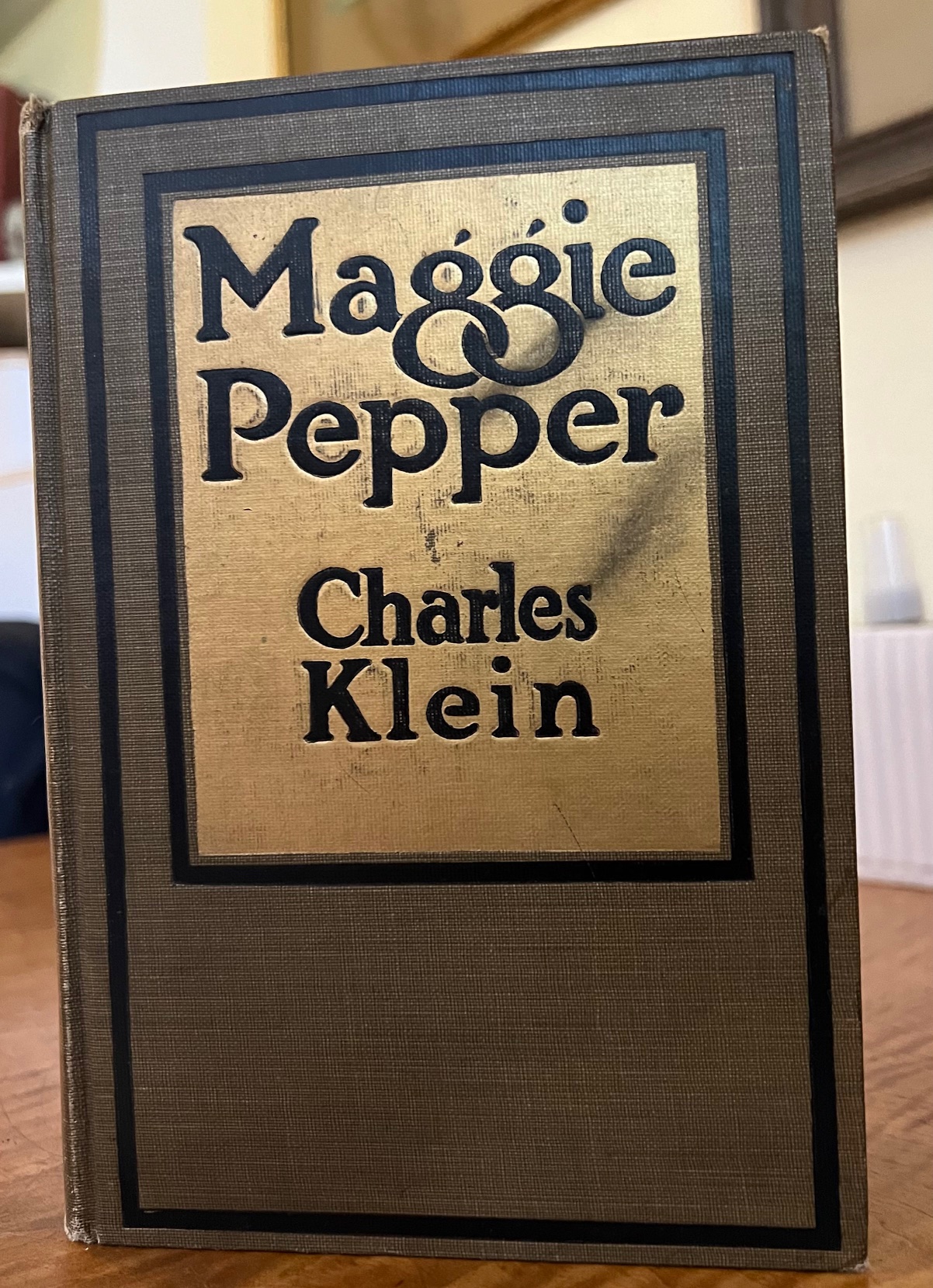
Maggie Pepper
Charles Klein
H. K. Fly Company, 1911
Maggie Pepper
Charles Klein
H. K. Fly Company, 1911
Description
[from review of Klein's play of the same name, The New York Times, Fri, Sep 1, 19111]
In "The Chorus Lady" Miss Rose Stahl, acting Patricia O'Brien, one of the wisest if no the loveliest of the merry-merrys, was able by self-sacrifice to save a little sister who slipped but did not fall. And now as Maggie Pepper in Charles Klein's play of that name Miss Stahl courageously extends her rescue mission work, so that at the end of the play she has three souls to her credit, including one adult male. Previous to her intervention he had borne the illuminative title of "the continental cut-up." This illustrious personage is no other than the proprietor of the department store in which Maggie Pepper is employed. And before the encounter with Maggie Pepper he had never done a day's work in his life. Then the affairs of the business are put into Maggie Pepper's hands, and the store, hitherto known as "the old curiosity shop," suddenly begins to prosper.
When it is further mentioned that in the course of the proceedings Maggie Pepper has to save her dead brother's child from a mother who steals, and a step-father who blackmails -- that ere the end of it she sees the man she loves shot down by the latter -- that she is able to nurse him back to health and strength in time to say she will marry him in the end -- it seems hardly necessary to add that the play is a melodrama*.
*Interesting side note, per Wikipedia, almost three quarters of a century later, a childhood picture of Rose Stahl 9from her biographical entry in an American stage encyclopedia) was featured in another melodrama: the romantic fantasy "Somewhere in Time" (filmed adaptation of Richard Matheson's "Bid Time Return" (1975) starring Jane Seymour and Christopher Reeve. The picture can be seen in this clip at :16, where Stahl, as a child Elise McKenna, is the small girl, to the right side of "her" entry, holding a doll.
Notes
Charles Klein, Brit-turned-American, actor-turned-playwright -- began his stage career in New York in the early 1880s. He switched to behind the floodlights work a decade later and his plays, modern melodramas-- he wrote 24 in total -- "were among the most successful of the first decade of the 20th century". Contemporary sketches raved not only about his plays' popularity, but their "bearings on the doings of the day." His "Lion and the Mouse", about a young woman taking on a business magnate (suspiciously resembling John D. Rockefeller), was soon followed by "the McCall investigation and certain crusades against corporation and insurance company graft." For its part, the staging of "Maggie Pepper" shortly preceded an announcement that Marshall Field & Co. "was to be conducted on a cooperative basis." Of course, association is not causation but, one article claims, "In nearly every city where Miss Stahl has played "Maggie Pepper," some part of the story of the play has been applied to some condition in one store or another in real life." (Edmonton Journal, Sat May 24, 1913) Klein seems to have spent part of the year writing in Europe -- in 1911 he wintered in France working on "a new play dealing with a subject that is inviting considerable interest -- namely, how to live in New York at the rate of ten thousand dollars a year with a three thousand-dollar income." (Trenton Evening Times 2 Dec 1911) (How indeed?) In May of 1915, he was again headed eastward, on the British luxury steamship the Lusitania, when he lost his life, age 48, in its sinking by the German submarine U-20 (which had its own "bearings on the doings of the day.") Four years later, the screen version of "Maggie Pepper" was directed by Chester Withey. It is one of 7200 movies produced between 1912 and 1929 that the Library of Congress considers "Lost US Silent Feature Films".
As for Maggie Pepper, the novelization: it's an entertaining, if not especially groundbreaking, read. Maggie is delightful character: practical and "keenly intelligent" (17), self-reliant, independent -- "No, I thank you kindly. The Privilege of handing my pay-envelope to some fellow every Saturday night don't appeal to me -- not a bit. I want to make my own way, without being hampered by a masculine expense-account" (67) -- she's also a loyal and sympathetic friend. At 30, she's older than the male main character, and from a different social class (she's been working in his family's department store since she was 15). Their friendship, then romance, work because he fully acknowledges her superior intellect and because their different skill-sets make them great partners --"the shrewd and ingenious Maggie...the receptive and industrious Joseph." (149) The nice thing about the book is that there's never a question -- from any of the characters -- that a woman could be the brains behind a spectacular economic enterprise. Molly "devoutly thank[s] heaven that she live[s] in a generation when woman is permitted to win success for herself in business life." (134) Joseph chafes that he can't publicly give her credit for the department store's transformation -- "I've stolen your laurels" (168) but the reason is not that she's a woman, but that she's "only" a shopgirl -- and he's the owner, and engaged. The story hits another note I always like -- a strong intergenerational friendship with another professional woman (the store detective). The big misunderstanding is kind of weak and the side-quest of saving her niece is what brings the melodrama in, but all in all, it's charming, deeply American story which maintains that the class circumstances a person starts out in, and their sex, should never stand in the way of the socioeconomic mobility they deserve by right of intelligence, ambition, and plain old hard work. Certainly it's large part fairy-tale, but to the degree a fairy tale can "have bearing on the doings of the day", Maggie Pepper was one worth telling.
Flags: domestic and child abuse, threatened child SA. A character, "Jacob Rothschild, jobber" can be read as a kind of uncomfortably, broad ethnic caricature, but Klein himself was Jewish and there is an explicitly anti-anti-Semitic (pro-Semitic?) message. Reviews of the play particularly call out the "irrepressible drummer" (Oakland Enquirer, Fri, May 2, 1913) as a plum role.
Tags
1910-1919, American, United States, Northeast, already taken, beautiful/handsome, blackmail, brave, courageous, charming, cheerful, clever, clueless, competent, dangerous rival, department store owner/heir, efficient, employer/employee, f/m, illustrated, immature, independent, inherited a child/instakid, intelligent, interclass, lovers, friends to, loyal, male, novelized play, orphaned, personal growth/becoming a better person, poor, rich, romance, selfless, shop worker, single, smart guy fooled by conniver, spirited, strong, strong f/f friendship, talented, third-person, working class, working girl with heart of gold, young
Flags
child abuse, domestic violence, insensitive racial/ethnic portrayal/stereotyping