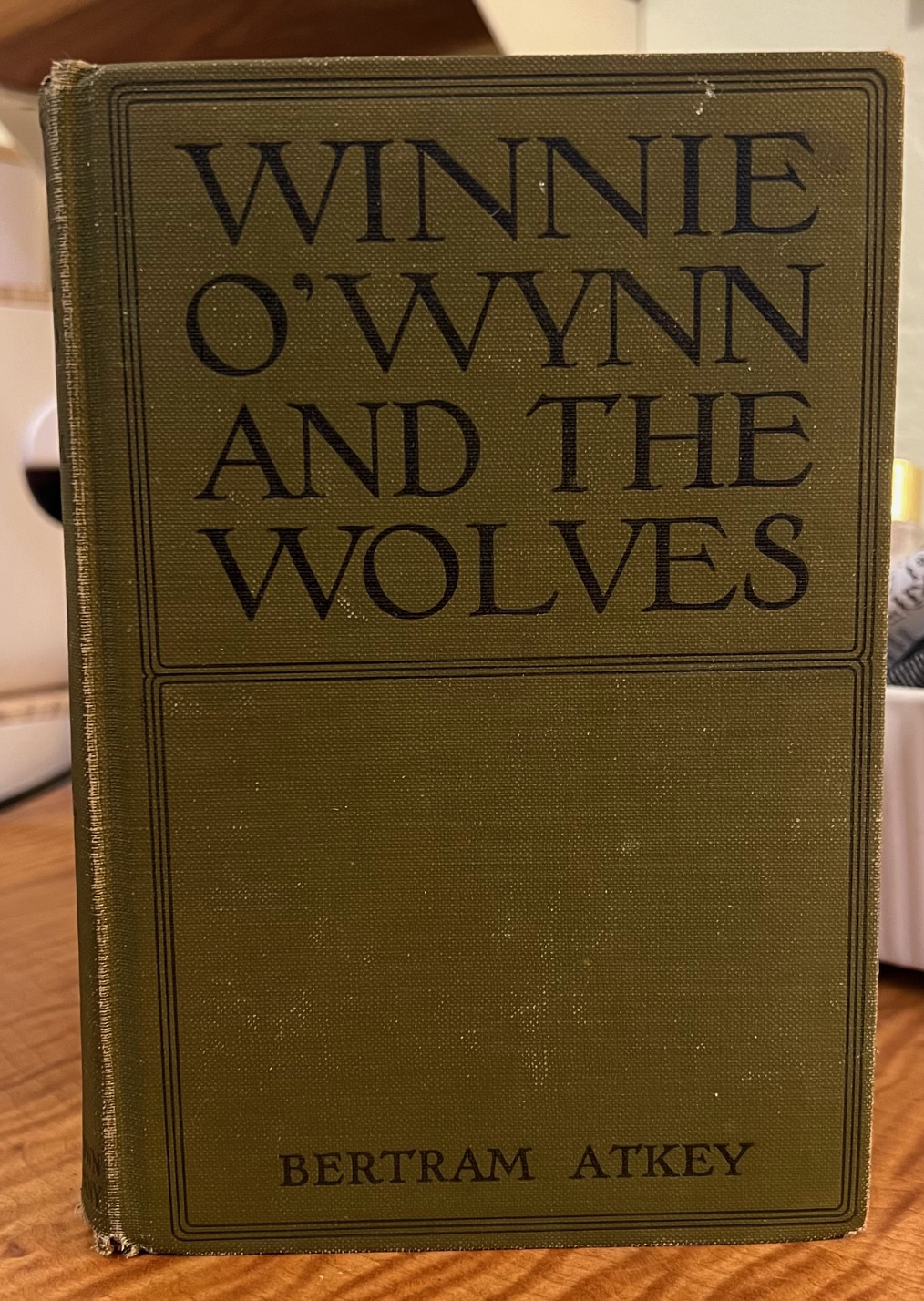
Winnie O'Wynn and the Wolves
Bertram Atkey
Little, Brown, and Company, 1922
Winnie O'Wynn and the Wolves
Bertram Atkey
Little, Brown, and Company, 1922
Description
[from review in the San Francisco Chronicle, Sun., Jan 29, 1922]
IN LAMB'S CLOTHING
Winnie O'Wynn Outwits the Unsuspecting Wolves
Miss Winnie O'Wynn, in Bertram Atkey's "Winnio O'Wynn and the Wolves," picks her wolves with unerring skill when she seeks her fortune in London with an equipment of good looks, no training, an equal lack of scruples, quick wits and a hundred pounds sterling, twenty of them acquired by her first experience in blackmail.
Winnie is able at once to find spectacular crooks, who are out-crooked at their own game by the combination of ingeniousness and ingenuousness of the "little girl from the country." Her get-rich-quick schemes are given justification by her care in outwitting only those who try to outwit her. If the wolves will persist in regarding her as a lamb because her fleece is white as snow, why, Winnie will show them that the wolf-appetite may assume other disguises than that of Red Riding-Hood's grandmother.
Her picturesque adventures are amusingly set forth, and the author deserves a vote of thanks for not reforming her in the last chapter. Gay and unregenerate and triumphant, we take leave of her, some £25,000 to the good for six months hunting, and scanning the horizon with innocent blue eyes, seeking for more wolves to conquer.
Notes
Bertram Atkey (1880-1952) was an English author and actor. He was a prolific writer — mainly of crime fiction magazine short stories and mystery novels/story collections. His detective (or detecting) characters included the upper-class vagabond Prosper Fair, the disabled (glasses, leg in brace) boy sleuth Wilson Chiddenham and, most famously, gentleman adventurer (read thief and swindler) Smiler Bunn. At least two entries in Atkey’s bibliography were filmed (The Hidden Fire as “The Secret Kingdom” in 1925, and the short story “After Dark” in 1924).
Winnie O’Wynn and the Wolves (1922) is a delightful and very funny episodic novel reproducing some of the best of his stories (and novellas) featuring the deceptively unworldly Miss Winnie. Most of these had been originally seen publication in The New Magazine and The Saturday Evening Post).
In the aftermath of an election outcome that felt, to say the least, dismissive of women’s rights and concerns, reading Winnie O’Wynn was a tonic. Winnie, 19, orphaned and nearly penniless, finds herself confronting a world of gendered power relations to the likes of which some today seem eager to return. Winnie quite naturally resents this, and sets about using her “sweet, childlike face” (64) and considerable intellect — “plenty of brains and few scruples” (10) — to right the balance. And to enhance her own, to the tune of thousands of pounds, a tasty wardrobe, and a two-year-old filly with plenty of go!
Winnie may be, frankly, a bit of a sociopath — her one true friend’s “Best-Beloved-in-the Mirror” (280) — but charmingly so, and she operates by her own moral code, so there’s always justice in the fleecing, and often times not just for Winnie.
Meant to be dipped into, not consumed in one sitting — and, taken that way, a very satisfying read. The Oakland Tribune, on its publication, declared Winnie would “prove entertaining both for the lover of frothy reading and the lover of the best in literature" (01/22/1922) and The New York Tribune praised Atkey for “transforming the old, and usually very dull tragedy of the wolves mangling the lamb into a bright, brisk comedy of the lamb skinning the wolves.” (Sun, Jan 15, 1922) Revenge, written well and with laughter: just what I needed this week!
Aside: There’s a sequel to Wolves, Winnie O’Wynn and the Dark Horses, published in 1925. It is VERY scarce. There are a few copies in collections in the UK, one (signed and non-circulating) at NYU and one in the New York Society Library’s collection. This last I requested through ILLiad, and when that was rejected, reached out to the library personally, explaining who I was, my project, promising to treat a loan carefully, and offering to scan and OCR it, for their own use and, if they were interested, for the public domain. I got a brief, impersonal reply.
Thank you for your inquiry.
Unfortunately, our copy of Winne O’Wynn & the Dark Horses* does not circulate through interlibrary loan due to fragile binding/poor condition.
I apologize for the inconvenience this may have caused.
While I can appreciate this thinking, I would be astonished if anyone has requested this title to read, in-person or remotely, for decades. When it comes down to it, I just don’t get institutions hoarding these old popular novels. For who? For what? They currently have no readership. This is what I’m trying to change. Please reach out with any ideas.
FLAGS: Frank, non-judgmental descriptions of drug addiction. Depiction of domestic violence.
Tags
1920s, English, Europe, England, beautiful/handsome, career, unusual, charming, clever, comedy, competent, determined, independent, intelligent, male, materialistic, money over love, none, not the type to fall in love, orphaned, practical, recommended, single, third-person, young
Flags
alcoholism/drug addiction or abuse, domestic violence