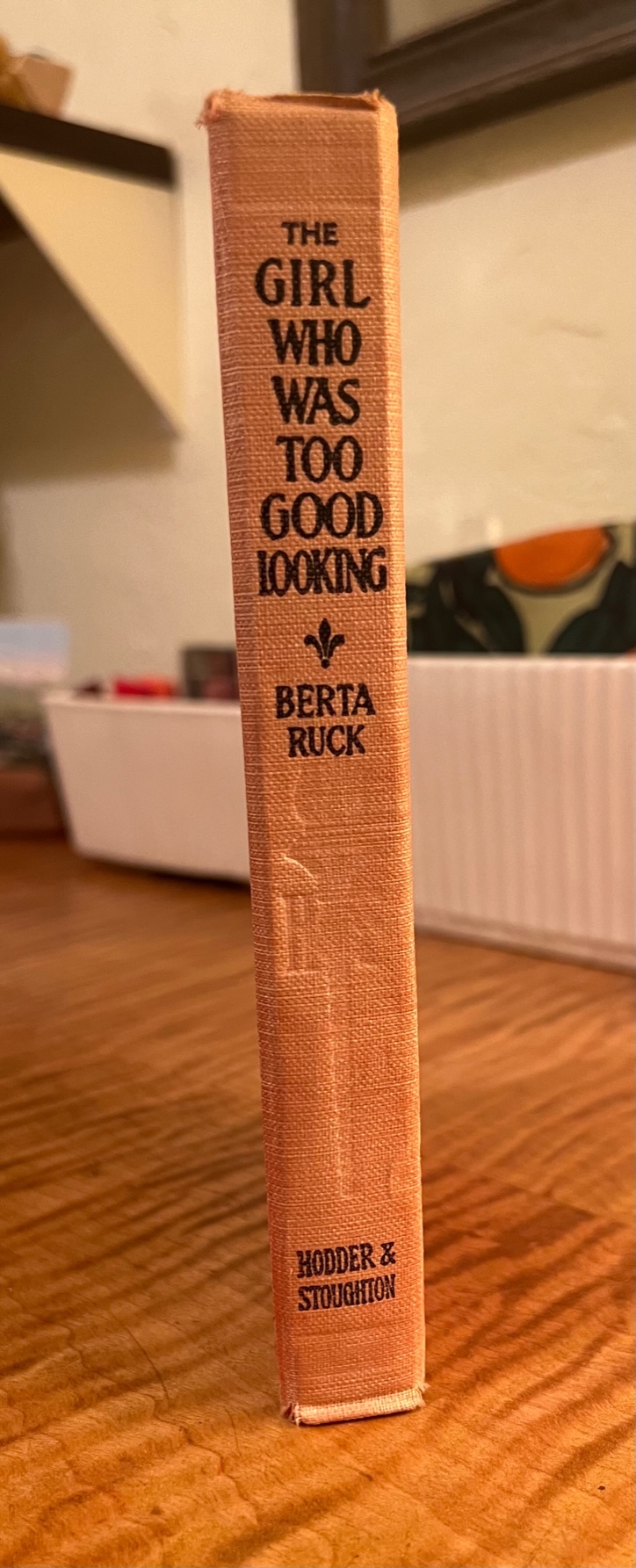
The Girl Who Was Too Good-Looking
Berta Ruck
Hodder and Stoughton, 1920
The Girl Who Was Too Good-Looking
Berta Ruck
Hodder and Stoughton, 1920
Description
This volume contains one novella, "The Girl Who Was Too Good-Looking" and several interlinked short stories, collectively titled "Auntie Up-To-Date". "The Girl" was serialized in British papers in 1916. Three of the included short stories ("The Great Unmet", "Rufus on the Rebound", and "The Dream Domesticated" appeared in Harper's Bazaar in 1918.
"The Girl Who Was Too Good-Looking" relates the plight of a girl who is just that: "penniless orphan of a country clergyman", she has to work, but is constantly losing jobs over the harassment of men or the jealousy of women. And this, though she is anything but a flirt and, in fact, long-engaged to a distant cousin out tea-farming in Ceylon. Her luck finally turns when she's hired by a kind, man-hating masseuse, and meets again the handsome young soldier who'd gotten her fired, unintentionally, from her first place.
In "Auntie Up-To-Date", still unwed -- and still youthful -- at 42(ish) Rose Mellicombe employs her generosity and considerable wits in helping a host of (insufficiently grateful) nieces and nephews resolve their romantic tangles and find the true love she, at their age, lost.
Notes
The novella "The Girl Who Was Too Good-Looking" is a straightforward, clearly written for serial, romance. Much of it covers the cost of beauty -- sexual harrassment and the double standard in which a girl pays for a man's unwanted flirtation. Was this partly to console young readers for being only "half-pretty"? As Helen Lovejoy's plainer school friend puts it: "I used to think it must be heavenly to be as beautiful as you are, Nell. But unless you've got private means to back you, it's better to be just moderately nice-looking, I do believe." (39) Most girls would feel they could, surely, muster that! "Too Good-Looking" borrows from The Bridge of Kisses the contrast between the young military hero and the older, fussy and peevish civilian fiance, though with significantly less character development (Bridge is just all-around better). The story spans the early years of the Great War, so there's some description of what British society's change to a war footing meant for young women. Otherwise, just a quick, pleasant-enough read.
More interesting are the "Auntie" stories, also war-set, but covering a wider range of themes from the cost of overprotecting middle-class girls to marriage as murderer of romance ("Stealing fire from heaven to light the kitchen range; and then having the chimney smoke!") to aging and what that meant for an unmarried woman of the 'teens. As usual, with Berta, there's some gender playfulness: the Sidney (F.) and Sidney (M.) who are engaged; Auntie, upon encountering a lonely young man (with no trace of judgment, "Incredible that it should happen to one so attractive! "It's not," I suggested, "that you don't like girls?" (178); and Auntie's own dating across the age divide "It is the nature of Boy to love once out of his generation" (238). Rose gets her happy ending, but it comes in an unexpected way -- I'm actually still not sure what I think about it! Asides: 1) First time I'd read this disparaging slang: "He says any man who can't get a girl nowadays must be a Conchy." (conscientious objector). 2) Future of balloons/dirigibles in military use still an open thing: "My eyes flew to a big framed photograph of the handsomest boy in the handsomest arm -- The Hot Air Service!" (205) 3) Those vintage British nicknames! In one chapter, two young Naval officers: "Rinkie" and "Bunface".
Tags
1910-1919, English, Europe, England, aunt, charming, clever, coming of age, cost of beauty, f/m, first-person, generous, love at first sight, loyal, middle-aged, not the type to fall in love, romance, second chance, selfless, soldier, spinster, third-person, veteran, war, young love, abetting
Flags
body negativity