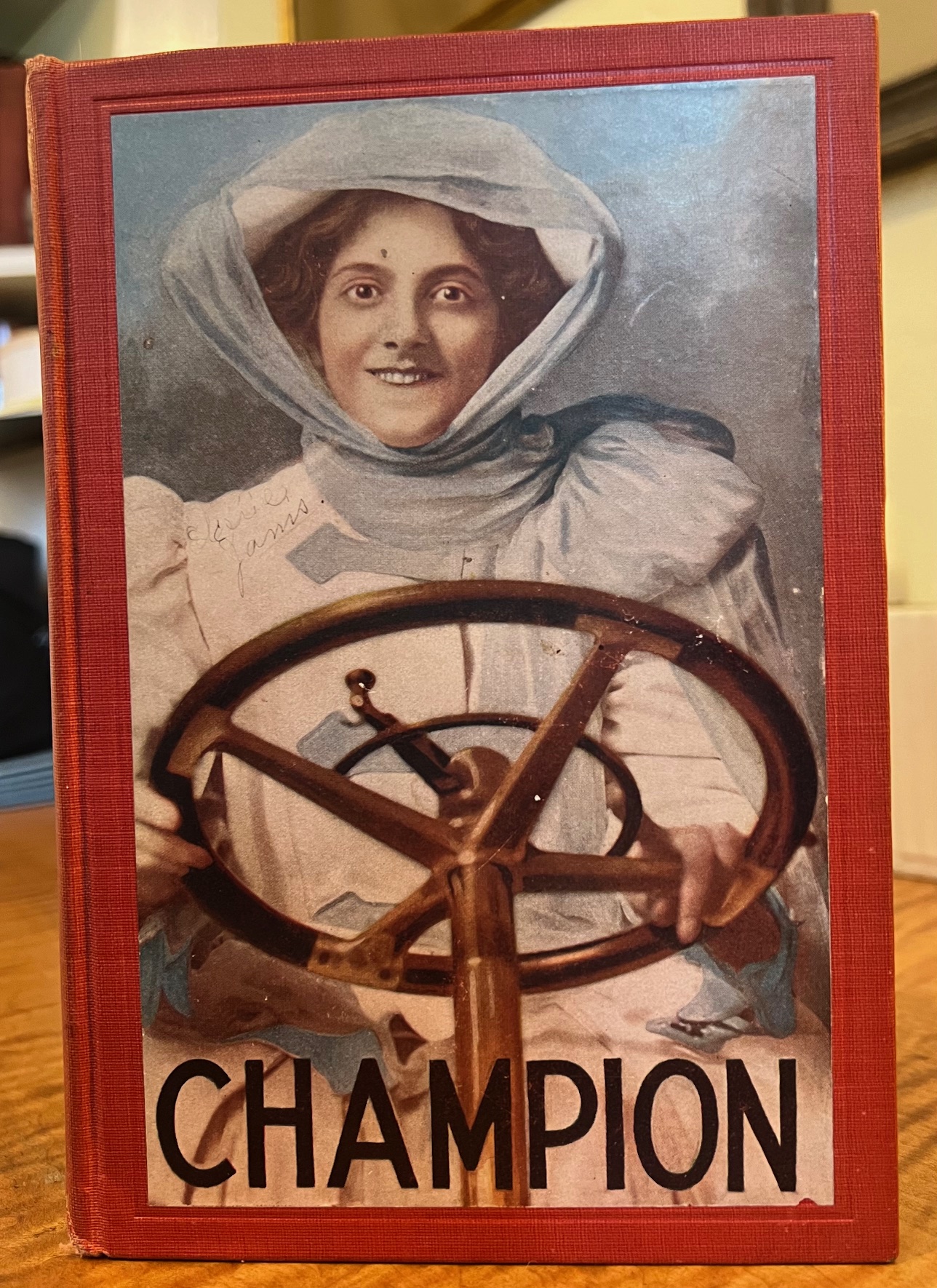
Champion (as John Colin Dane)
Alice Muriel Williamson
G. W. Dillingham Company, 1907
Champion (as John Colin Dane)
Alice Muriel Williamson
G. W. Dillingham Company, 1907
Description
[from review in the the Spokesman-Review (Spokane, Washington) Sun, Sep 8, 1907] Hugh Cameron, a young Englishman of good birth, but bad income, takes all the money he has in the world, a small legacy from an uncle, and builds himself a motor car, which, if successful, will make his fortune. For it has an aeroplane attachment, which makes it as near a bird as anything built to stay on the ground can be. Champion it is baptized and a champion it proves, both in speed and heart, for the automobile itself tells the story of its own and its master's woes, with all the devoted blindness of a faithful servant for a kind master.
The car is finished, the secret well kept, the fortune of the master is in the hands of the machine. Champion learns from conversation carried on around him many facts concerning his mater's past and his hopes for the future. He has been entered for the great Vandervoorst cup race for inventors. His great and only rival is a certain Gilbert Barr-Simons, an unprincipled millionaire, also with a car of his own invention, yet lacking the one peculiar touch which gives Champion the great advantage.
But a French chauffeur has been helping Hugh and is bribed by the rival to discover all the secret, betray it and his employer. Till the day of the great race, he has accomplished nothing. The 100 thrills that the description of that event and its outcome creates must be read in the author's own words. It makes a capital story, full of many sensations -- suspense, hope, fear, and indignation -- for the author has managed to make the car so human that the keenest sympathy is aroused and sustained from the very first page.
After the race various adventures befall the poor car and it seems many times as if it must become a back number and belong only to the junk heap. Repainted, with a new outside, separated from its beloved master, ill-treated and in a foreign land, its fortunes look black, indeed, when one day it is bought by an American, whose daughter has ranked next to his master in the heart of the car, and is taken to England. There along every road its engines sing "The March of the Cameron Men" until a certain bright day comes and fortune smiles on love of both girl and car. The book will make one of the best hammock novels of the season.
Notes
John Colin Dane is a pseudonym of the "literary polymath" Alice Muriel Williamson.
If you've always wished you could read an adventure story narrated by a sentient, gender-fluid (see below) 120 hp racecar, Champion is your chance. It may not be the fastest-moving book you've ever read, but Dane/Williamson does a surprisingly convincing, and entertaining, job portraying an alternate (or is it?) reality where autos think and feel, have a degree of free will and even, dare we say it, a soul (74). The world and the voice are less Cars than KITT: Champion isn't as snarky but he-she's every bit (and every bit as lovably) the British snob. Re. the ferry to France, he sniffs:
as for the silly, rolling motion in which that boat indulged herself when she had lolloped out of the harbor, it was undignified and even indecent. I was thankful when she made up her mind, with an idiotic yell, to seek refuge in the quiet water again, which turned out to be in Dieppe harbor..." (72)
It's a lot of fun, as is Dane/Williamson's imagining of what the physical experience of being a car would be like: "I listened with all my valves" (24), "To dream of running over it at full speed was enough to demagnetize your coil" (115), "I had but a few seconds to carburate these reflections" (181), etc., etc.
The best part of the book, and what comes through most strongly, is the wonder and excitement of the automotive revolution. There's a real sense of the joy of this new thing, driving -- in this case from the car's perspective -- "I was matter informed by mind... Existence was flight, and flight was an ecstasy made up of strength and speed" (114) and it makes you want to get out and into your own machine "of living fire...pulsing with life" and "devour the straight white miles as if they [were] long moonbeams." (58) I'm kind of skeptical of the physics and practicality of cars with retractible, vacuum-like propellers -- Champion's great innovation -- but his experience makes you appreciate why, in so many of the books from this time, the best and the brightest young male characters were trying to make their names in automotive engineering and design.
Champion also features one of my favorite tropes -- which you'll find in some of the Williamsons' other work -- the breath-of-fresh-air, new-century American girl doted on by, and bossing, her rich dad. "Not consent!" repeated the girl. "To something I want? Why, what do we American girls bring up their fathers for?" (100) What, indeed?
Nicely illustrated by Walter Ernest Webster.
Flags: A bit of ethnic chauvinism. Discussions of suicide.
*"No doubt he had made me with a dual nature, and at certain moments my masculine attributes were uppermost, at others my feminine." (34)
Tags
1900-1909, American, American girl bosses rich dad, English, Europe, England, Europe, France, Europe, Monaco, Scottish, accident, vehicular, car crash, adventure, ambitious, beautiful/handsome, blackmail, clever, competent, dangerous rival, determined, engineer, f/m, first-person, heir/heiress, independent, intelligent, kind, loyal, male, nobility/royalty, noble/aristocrat, nonhuman narrator, poor, principled, race car driver, rich, romance, single, strong, talented, tall, young
Flags
suicide